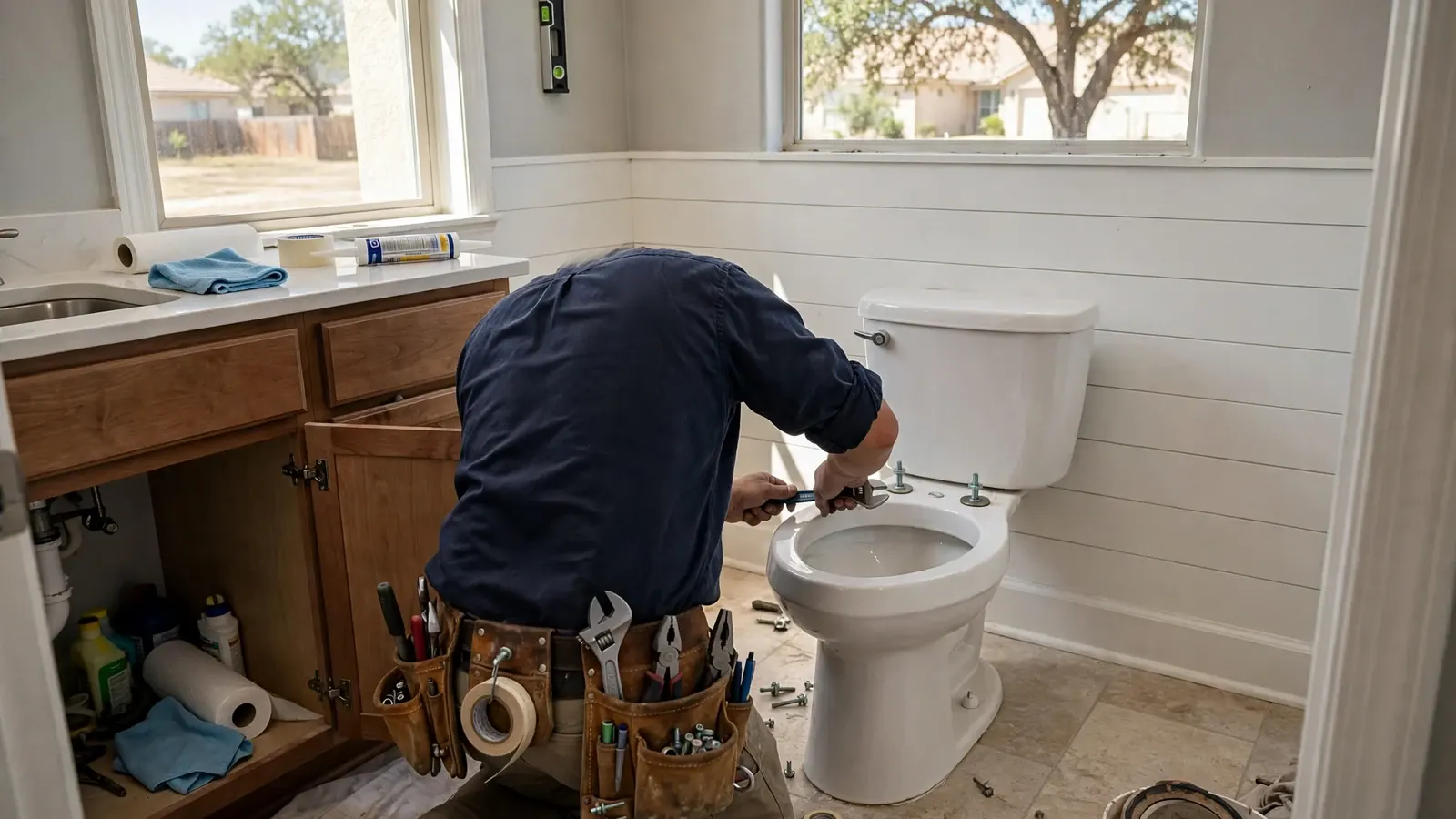
Toilet bolts, also called closet bolts, are the two long bolts that slide into slots in the floor flange and hold the toilet to the floor. To install them, slide the head into the flange slot, set the toilet over them, add washers and nuts, and tighten each side a little at a time until the bowl stops moving. Do not crank one side all the way down, because the porcelain can crack.
A toilet that rocks has usually lost its seal. Water leaks at the base, and a smell may follow. Our toilet repair team sees this often in older buildings across Brookline, Allston and Brighton. Below is the full process, plus the signs that mean you should stop and call (617) 752-0573.
Signs the toilet needs new bolts or a new seal
Bolts that loosen are common. Bolts that corrode away mean a larger repair.
- Rocking when you sit. Loose nuts, a warped floor or a cracked flange.
- Water around the base. The wax ring is no longer sealing.
- Sewer smell. The seal is broken or the flange is damaged.
- Rusted caps and nuts. The bolts have corroded and may snap if you force them.
- Soft or stained floor. Water has been getting out for a while. Stop and have it looked at.
Flange cracked or floor soft?
Stop here. Call dispatch before you lift the bowl again.
What to have on the floor before you start
A trip to the hardware store mid-job leaves the bowl off the flange and the sewer gas coming up. Gather everything first.
| Item | Detail | Why |
|---|---|---|
| Closet bolt set | Brass or stainless, 5/16 inch by 3 inch | Brass or stainless resist rust |
| Wax ring | Standard or extra thick, with or without a horn | Fits the flange height |
| Flange extender or repair ring | Optional | Raises or reinforces a low or broken flange |
| Shims | Plastic | Level a toilet on an uneven floor |
| Adjustable wrench, putty knife | Standard | Tighten nuts, scrape old wax |
| Rags and a bucket | Standard | Drain the tank and bowl |
Installing new closet bolts and a wax ring
This process assumes the flange is sound. If it is not, skip to the next section.
- Shut the water. Close the stop behind the toilet, flush, and sponge out the tank and bowl.
- Disconnect the supply. Unscrew the supply line from the tank. Have a rag ready for drips.
- Remove the caps and nuts. Pop the plastic caps and loosen the nuts. If they spin, hold the bolt with pliers.
- Lift the toilet. Rock it gently to break the seal, then lift it straight up. Set it on towels. It weighs 60 to 90 pounds, so bring a helper.
- Scrape the flange. Remove the old wax with a putty knife. Stuff a rag in the pipe to block sewer gas while you work.
- Fit the new bolts. Slide the heads into the flange slots. Space them evenly on each side, with threads pointing up.
- Set the wax ring. Place it on the horn of the bowl, or press it on the flange if using a ring without a horn. Do not squash it.
- Lower the toilet. Align the holes over both bolts and lower it straight down. Press with your weight, without twisting.
- Tighten in turns. Washers on, then nuts. A quarter turn left, a quarter turn right, until firm. Stop when the bowl no longer moves. Trim the bolts and fit the caps.
If the toilet still rocks after tightening
Do not keep tightening. Overtightening cracks porcelain, which cannot be repaired. Instead, shim the gap under the base with plastic shims, tighten gently, then trim the shims flush with a utility knife and caulk the base for a clean edge.
If shims do not stop the rock, the floor is uneven or the flange sits below the surface of the finished floor. That is when a flange extender or a floor repair is needed.
Old cast iron flanges: what to look for
Many older Brookline buildings have a cast iron or lead closet bend with a brass or cast iron flange. These can rust, crack at the bolt slots or loosen from the floor. A bolt slot that has broken off cannot hold a bolt.
Look under the toilet with the bowl off. A good flange is flat, firmly anchored, and sits at or slightly above the finished floor. A flange that wobbles, has a missing slot, shows heavy rust flakes or sits well below the floor needs a repair ring or a replacement.
A cracked cast iron flange, or a pipe that moves when pushed, is not a homeowner repair. Stop, plug the opening with a rag, and call. If water has been leaking for a while, our leak detection crew can check below for damage.
Call a plumber if you see any of these
Some problems need a licensed professional and cannot be fixed with a new bolt.
- A cracked or broken flange, or a closet bend that moves.
- A soft, black or spongy subfloor around the toilet.
- Bolts so rusted that the nuts will not turn and the head spins.
- A toilet that leaks again within days of resetting.
- Any sewage backing up into the tub or floor drain, which points to a line problem.
Older floors, old pipe and who does what
The median Brookline housing unit was built in 1938, and about 52 percent of units date from 1939 or earlier (U.S. Census American Community Survey, 2020 to 2024 estimates). In buildings from that era, expect cast iron stacks, old floor flanges and plank subfloors under tile. That matters because a flange set in lead or an old cast iron collar breaks when forced.
Massachusetts says permits for plumbing work are issued only to licensed plumbers, and the Brookline Building Department says homeowners cannot pull plumbing permits (per the state consumer fact sheet and the Town's FAQ). Resetting a toilet on a sound flange is routine repair. Replacing the fixture or piping in the wall is different, so ask the Building Department if your building requires a permit.
If sewage backs up and more than one drain is affected, the Town says it is responsible for blockages in the public sewer main and the homeowner for the service line to the main. The Town's sewer backup line is 617-730-2175 (per the Town's Water and Sewer FAQ).
Toilet bolt questions
Most closet bolts are 5/16 inch by 3 inch, in brass or stainless steel. Check the flange slot width and floor thickness. Longer bolts can be trimmed with a hacksaw.
The floor may be uneven, or the flange is below the finished floor. Plastic shims fix a small gap. A big gap needs a flange extender or floor repair.
Yes. A wax ring is a one-time seal. Once it is crushed or lifted, it will not reseal reliably.
Only if they are clean and not corroded. Bolts are cheap, and a new set removes a failure point.
Snug, not strained. Tighten each nut a quarter turn at a time, alternating sides, until the bowl is firm. Overtightening cracks the porcelain.
Cast iron flanges and old closet bends can break when disturbed. A repair ring sometimes works on small cracks, but if the pipe moves or has lead joints, stop and call. Plumbing in older Brookline buildings is often connected to a shared stack, which makes mistakes expensive for neighbors.
Yes. Dispatch is open 24/7, with same-day appointments when available. Close the stop behind the toilet and call. Also see our plumbing installation page if you are replacing the fixture.
Want it reset the right way?
Call (617) 752-0573.