If water is coming through a ceiling or pooling on a floor right now, call (617) 752-0573. Dispatch for leak detection in Brookline runs 24/7. While you wait, close the main shut-off valve, stay clear of wet outlets and light fixtures, and set a bucket under any drip.
Most leaks are quieter. They sit behind plaster, under a basement slab or in the line between the sidewalk and the house, and show up first as a high bill or a meter that will not stop. Leak detection locates one leak accurately, so the repair opens a small patch instead of half a room.
Signs of a hidden leak in an older Brookline building
Water usually shows itself indirectly. These are the signs that send people to us, and any one of them is enough reason to call.
- Meter still moving. Every fixture is off, nobody is home, and the dial or the small triangle on the meter keeps turning.
- A bill that keeps climbing. Usage rises over two or three bills with no change in who lives there.
- Stains and soft paint. A tan ring on a ceiling, bubbling paint on a wall, or plaster that feels cool and damp.
- Warm or damp floor. A patch of floor over a hot water line that is warmer than the rest.
Water spreading right now?
Close the main, stay clear of wet outlets, and call (617) 752-0573 any hour.
Active leak: what to do first
Close the main
Turn the main valve clockwise. Check the meter to see if it stops moving.
Keep clear of electricity
Stay away from wet outlets, switches and ceiling lights.
Catch and move
Set buckets under drips and lift rugs and boxes off wet floors.
Note what you see
Photos of stains, the meter reading and the time help the search and any insurance call.
Meter still running or the bill is high: a test you can start tonight
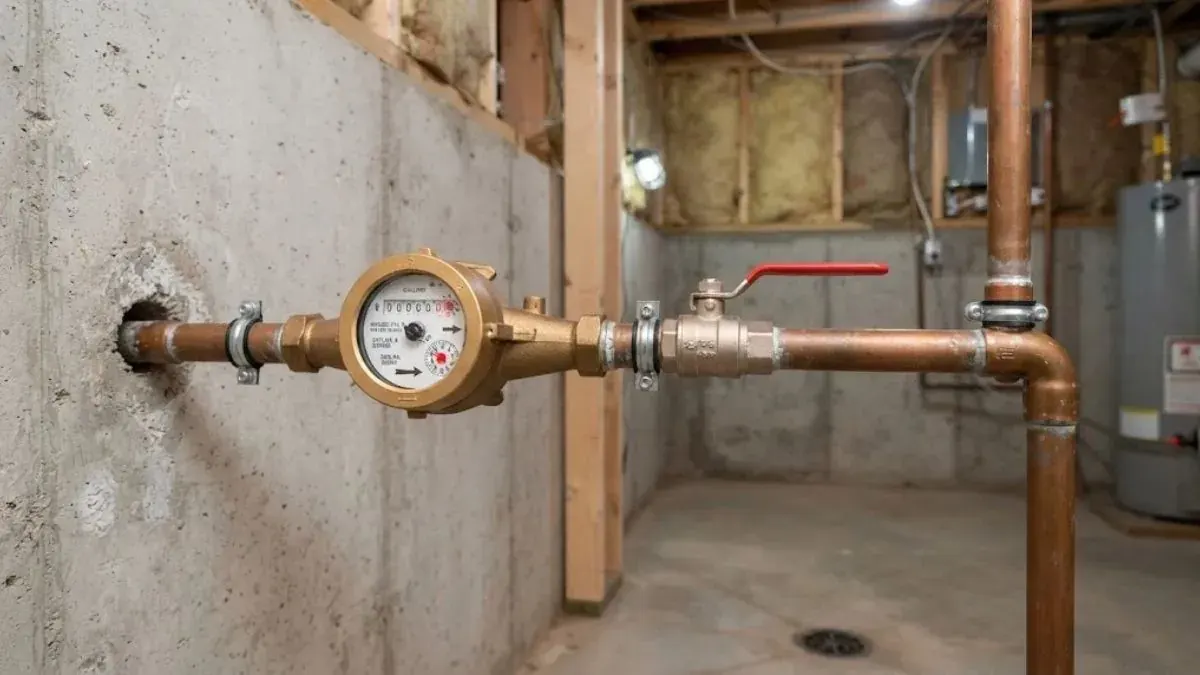
Close every faucet and make sure the dishwasher, washer and ice maker are idle. Find your meter, usually near where the water line enters the basement, and watch the leak indicator or the sweep hand for a few minutes. Movement means water is leaving the system somewhere.
Next, shut the main valve inside the house and look again. If the meter stops, the leak is inside the building. If it keeps turning, the loss is on the buried line between the meter and your main valve, or on the street side of the meter, and that changes who owns the problem. Our write-up of the water service line explains the Town and owner split.
Brookline's billing office, at 617-730-2170, handles bill questions, and the Town lists leak abatement among its billing topics. Ask what documentation it wants before you pay for a repair.
How we locate a leak without opening the wall
We start by narrowing the zone with the meter test, a pressure check on the supply lines and a look at where the water is showing up. Then we pick the tool that fits what the building is made of.
- Pressure isolation. We close sections of the supply piping one at a time and watch a gauge, which tells us whether the loss is in the hot side, the cold side or the main.
- Acoustic listening. A ground microphone or contact sensor picks up the hiss of pressurized water escaping, and we compare readings along the pipe run until the sound peaks.
- Thermal imaging. An infrared camera shows cool wet areas on walls and ceilings and warm tracks where a hot line is leaking into a floor.
- Confirm and mark. A moisture meter confirms the wet zone and a small camera can look into a cavity through a hole the size of a coin. We then mark the spot and explain the repair before any cutting.
Ceiling, wall and basement leaks in pre-war buildings
Per the Census Bureau's 2020-2024 American Community Survey, 51.7 percent of housing units in Brookline were built in 1939 or earlier, and the median year built is 1938. That means a lot of galvanized and early copper supply pipe, old drain stacks, and plaster ceilings that hide the plumbing above them.
A ceiling stain rarely sits under the leak. Water travels along a joist or down a pipe before it drips, so the wet spot on the second floor may come from a fitting over a bathroom one floor higher. In a three-decker or a condo building, as in nearby Allston, the source may also be a neighbor's unit, and we document where the moisture reading is highest to help the building sort that out.
Buried lines, slabs and the yard
Under a basement slab or in a crawlspace, a leak can run for months before it shows. Warm patches in a slab, the sound of water at night, or a damp spot where the foundation meets the floor all point us toward the slab or the line below it.
Outside, we check the line from the sidewalk shut-off to the house, the meter box, and irrigation or hose-bib lines. A sprinkler valve that runs fast or one soggy strip of lawn is a typical sign. We also survey pool and spa plumbing for leaks, but we do not rebuild pools.
What happens once the leak is located
If the find shows an active burst, the next step is burst pipe repair. If it is a connected fixture, we fix that fixture on the same visit when parts are on the truck.
| Where it is | Typical fix | Trade-off |
|---|---|---|
| Exposed basement pipe | Replace the bad section or fitting | Fast and simple, but nearby old pipe may fail next |
| Inside a wall or ceiling | Open a small access, repair, patch | Plaster and paint repair is a separate trade |
| Under a slab | Reroute the line overhead, or break the slab and repair | Rerouting avoids concrete work but shows new pipe |
| Buried service line | Spot repair or replace the run | Needs excavation rules and utility marking, see service line repair |
| Many leaks on old supply pipe | Plan a repipe | Costs more now, ends the chase |
We repair the plumbing. Drywall, plaster, flooring and paint are separate trades.
What moves the price of leak detection
We do not quote a number sight unseen. These things set it.
- Size of the searchA single bathroom wall is a short job. A whole three-decker with several risers takes longer.
- MaterialsPlastic and copper carry sound differently, and cast iron or galvanized pipe can muffle it.
- AccessOpen basement ceilings are quick. Finished rooms and tight chases take more care.
- Outside workA buried line, meter pit or yard run adds locating time and may need utility marking before any digging.
- After-hours timingA leak that is soaking a ceiling at night is handled differently from a slow bill problem booked for the next day.
Most homeowner and condo policies cover sudden water damage but often exclude the cost of finding the leak or repairing a slowly leaking pipe. Read your policy, and ask your insurer what they want in writing before you start.
Want your real number? Call (617) 752-0573.
Leak detection questions
Yes. Dispatch answers 24/7, and when a leak is actively damaging a ceiling or floor we send a technician as soon as one is free. Same-day appointments are available for non-urgent calls when the schedule allows. Shut the main valve while you wait.
The loss is probably hidden in a wall, under a slab, or in the buried line. Run the shut-off test described above to learn whether it is inside or outside your main valve. A running toilet can cause the same reading, so check those first.
The Town of Brookline lists leak abatement among the topics its billing office handles. Call 617-730-2170 to ask what they require. We can give you a written description of what we found and fixed.
We do, in small commercial spaces and mixed-use buildings along streets like Beacon and Harvard. Larger sites with fire mains or campus-scale lines may need specialized survey equipment, and we tell you when that is the case.
It depends on your documents. Pipes inside your unit are often yours, while risers and stacks usually belong to the association. Our moisture readings show where the water is concentrated, which helps both sides decide.
Stop guessing where the water goes
Dispatch is open 24/7 at (617) 752-0573, with same-day appointments when available.