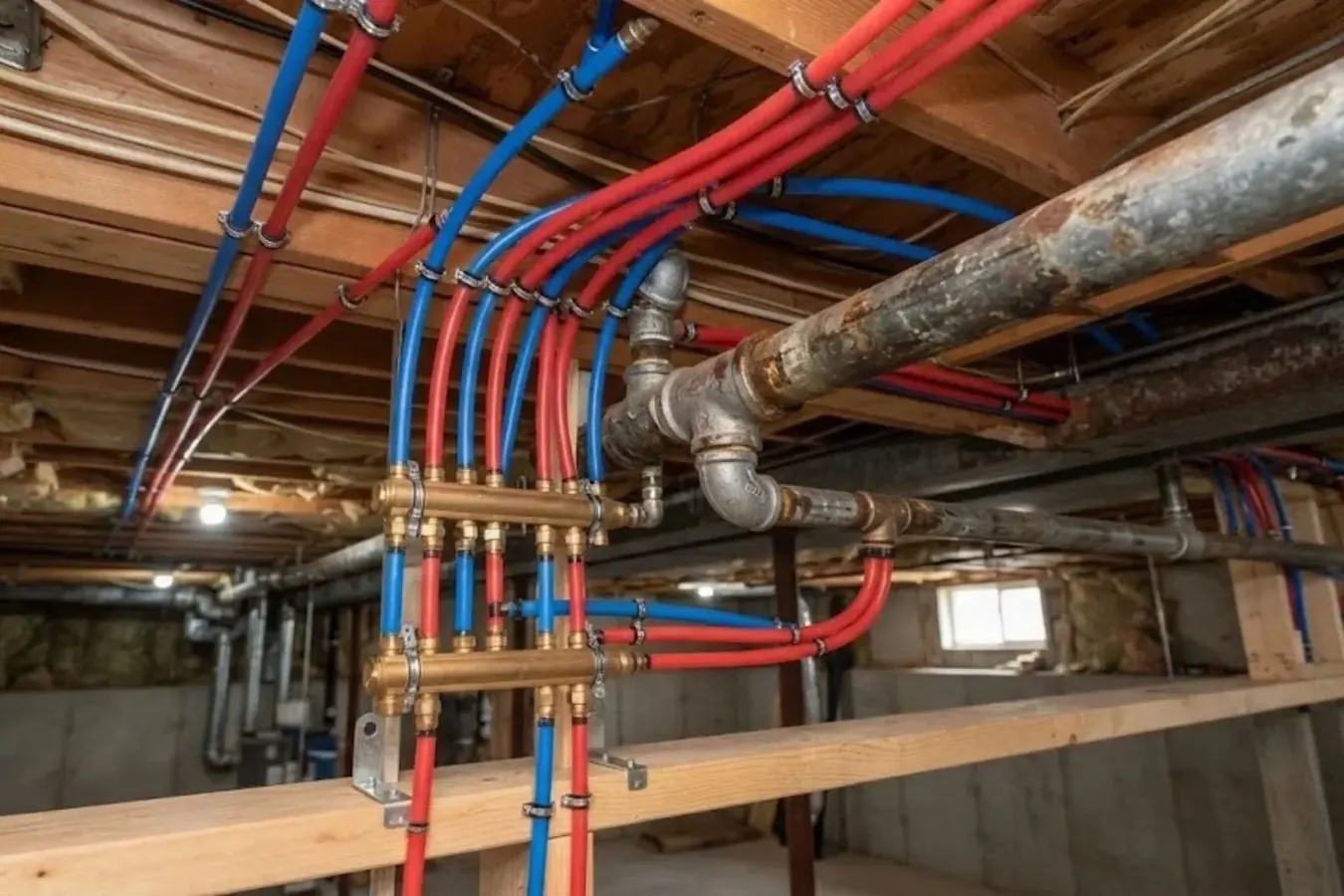
Repiping in Brookline usually means taking out galvanized steel or aging copper supply lines and putting in new pipe, so water arrives clean and at full pressure. It is a planned project, not an emergency, and the work can be staged around people who live in the building.
If a pipe is actively spraying, that is a different call. Close the main valve and phone us at (617) 752-0573 for burst pipe repair, then come back to this page when the water is stopped.
Why so many Brookline buildings are due for new supply pipe
According to the Census Bureau's American Community Survey (2020-2024 five-year estimates), 14,941 of Brookline's 28,873 housing units, or 51.7 percent, were built in 1939 or earlier. The median year built is 1938. Many of those buildings have been remodeled, but the pipe behind the plaster often has not.
Pre-1940 supply plumbing was typically galvanized steel, later copper with soldered joints, and in some places lead was used on services and fittings. Each fails in its own way, and none of them lasts forever. Age alone is not a reason to rip everything out, but it is a reason to know what you have.
Rust in the water?
Call (617) 752-0573 to plan a survey of your supply pipe.
Signs your supply pipes are wearing out
- Brown or orange water. Rust flakes loosen from inside galvanized pipe, especially after the water sits overnight.
- Weak pressure at several fixtures. Mineral and rust buildup narrows the pipe until a shower dribbles.
- Pinhole leaks. Small green or white crusted spots on copper, or leaks that reappear at different spots.
- Repeated repairs. A second or third patch on the same line in a year or two.
- Visible corrosion at joints. Flaking, blue-green crust or weeping threaded fittings in the cellar.
Repeated hidden leaks also send people to leak detection, and the findings often tell us whether patching or repiping makes more sense.
PEX or copper: the real trade-offs
Neither is wrong. Your choice depends on access, budget and what the building association or landlord allows. We explain the pros and cons on site and give you a price for each option.
| Factor | PEX | Copper |
|---|---|---|
| Installation | Flexible tubing, fewer joints, less wall opening | Rigid, more cutting and soldered joints |
| Freeze tolerance | Expands more before splitting | Splits more readily |
| Longevity record | Shorter track record, but widely used | Decades of proven service |
| Appearance | Plastic, usually hidden | Metal, can be left exposed in a cellar |
| Effect on water | No metal leaching | Can corrode under some water chemistry |
| Common use | Whole-house replacements and long runs | Exposed runs and where owners prefer metal |
Many repipes mix them: PEX through walls, copper where the pipe shows.
MWRA water and corrosion control
MWRA supplies Brookline's water and says it adjusts pH and alkalinity with sodium carbonate and carbon dioxide to reduce the corrosion of lead from home plumbing. Its Brookline 2025 results showed a lead 90th percentile of 1.29 ppb, with none of 20 samples over the 15 ppb action level.
That is a good sign for the water, but it does not tell you what is in your own pipes. If you want to test your tap, contact the Town's water office at 617-730-2170 or the MWRA hotline at (617) 242-5323, and ask what is available. We do not test water ourselves.
Phased repiping in an occupied building
You do not have to empty the building. In a triple-decker or condo stack, we usually plan the project in phases so water is off for hours, not days.
- Survey. We trace the lines, open test spots and decide which run goes first.
- Phase one: risers and mains. The cellar mains and vertical risers are replaced, with temporary water restored at day's end.
- Phase two: branch lines. Kitchen and bath branches are replaced one unit at a time.
- Pressure test. Every new run is tested before walls are closed.
- Permit and inspection. Your plumber pulls the permit and the town inspects the work, through the Building Department.
Plaster and tile repair after access cuts is a separate trade. We keep openings small and can coordinate with your painter or contractor.
Permits, owners and the shared stack
Replacing supply piping is plumbing work that needs a permit. Under Massachusetts rules, permits are issued only to licensed plumbers, and Brookline's Building Department confirms that homeowners cannot pull plumbing permits. Review takes about three days, and the Town's online portal handles filings.
In condos, a repipe often touches common risers and unit lines at once. Check with the association before the first cut, and see how plumbing installation coordination works for multifamily work. If the old line is also the buried feed, the next stop is water service line repair.
What sets the price of a repipe
No two repipes cost the same, because the walls are different. These are the biggest factors.
- Size of the buildingNumber of floors, bathrooms and kitchens decides the footage of pipe.
- Material choicePEX, copper or a mix change both parts and labor.
- Wall accessOpen cellar ceilings are fast. Plaster-and-lath walls and tile take longer.
- PhasingWorking one unit at a time in an occupied building adds visits but reduces disruption.
- Permits and inspectionPermit review and inspection timing affect scheduling.
Repiping for wear is usually a maintenance cost that insurance does not pay. Water damage from a sudden burst may be covered. Read your policy to see how it treats slow leaks versus sudden failures.
Want your real number? Call (617) 752-0573.
Repipes in neighboring towns
We also repipe older homes in Newton and Jamaica Plain. The approach is the same: survey first, then decide what to replace.
Repiping questions
Galvanized pipe is gray steel with threaded joints. A magnet sticks to it, and a scratch shows a dull silver color. Copper is orange-brown and a magnet will not stick.
Older copper plumbing often has soldered joints that may contain lead. The only way to know is to test or replace. Ask the Town's water office or MWRA about testing your tap.
It depends on the building. A small house can be done in a few days, while a multi-unit building is staged in phases. We give a schedule after the survey, and same-day appointments are available for the survey when the schedule allows.
Usually yes, with planned water-off windows. We restore temporary water at the end of each work day where possible.
Supply piping is the main repiping scope. Drain and waste lines are separate, and we assess them on the survey. If a leak is sudden, call our 24/7 dispatch.
Yes. The permit goes through a licensed plumber, and Brookline homeowners cannot pull plumbing permits. The Building Department inspects the work.
Plan the repipe, not the flood
Call (617) 752-0573 for a survey and a clear price before work starts.