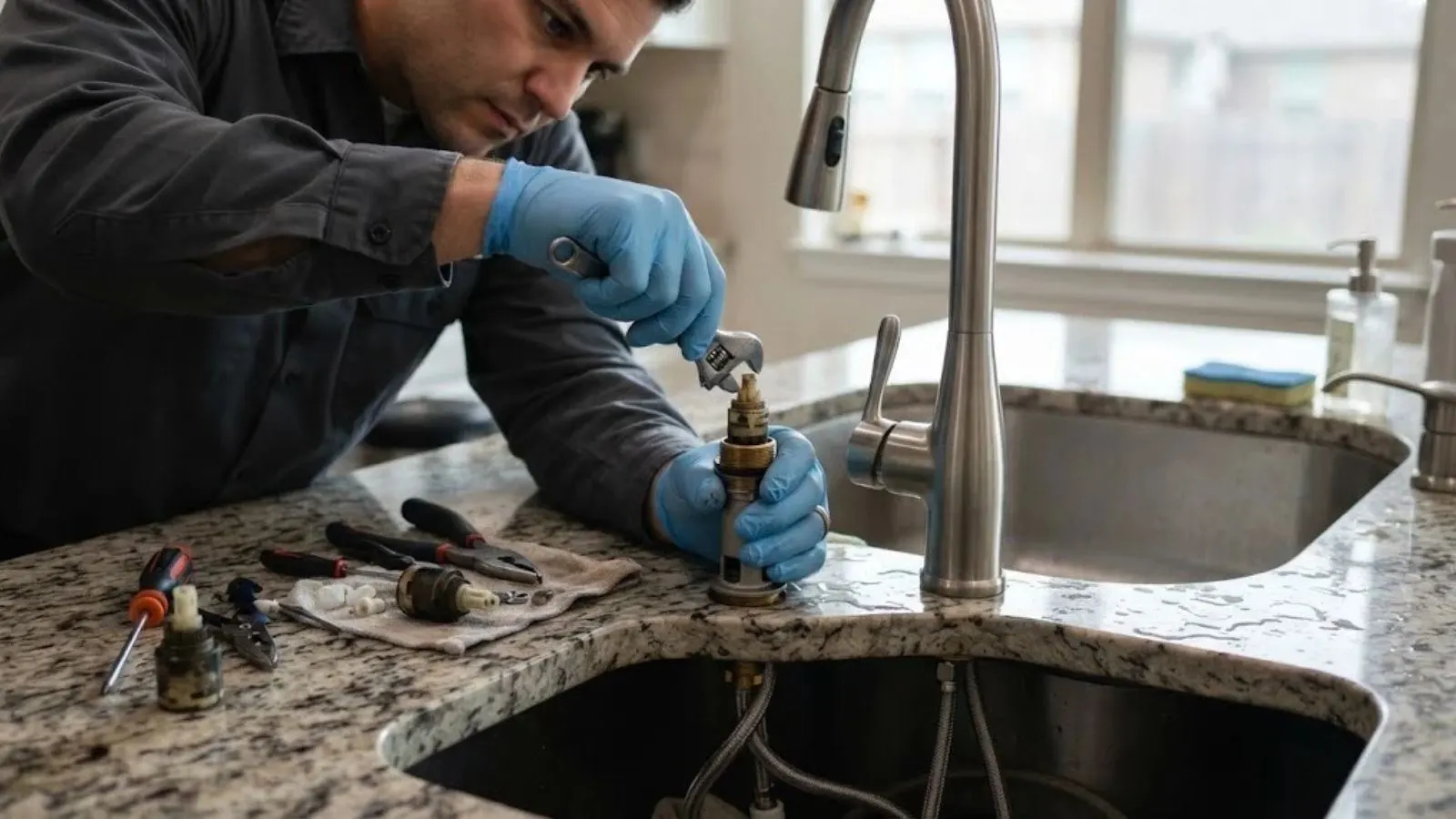
Under a bathroom sink you will find two supply lines with shutoff valves (called stops), a drain tailpiece, a curved P-trap, a wall pipe called the trap arm, and on most sinks a pop-up rod linking the stopper to the faucet lever. That is the whole system. Water goes in through the stops and out through the trap.
Most problems are a dripping joint, a slow drain or a stopper that will not hold water. You can handle several of these with a bucket and a pair of pliers. A few, like a corroded stop that will not turn or a wet wall behind the trap arm, need a plumber. If your faucet itself is the problem, see our faucet repair service. We run the same checks in older flats across Allston and Jamaica Plain.
Reading the cabinet from the wall to the floor
Start at the wall and work down. Each part has one job.
- Supply stops. Two small valves on the wall or floor, hot on the left, cold on the right. A quarter-turn or multi-turn handle shuts water to this sink only.
- Supply lines. Braided stainless or chrome-plated tubes between each stop and the faucet. They have a rubber or fiber washer inside the nut.
- Pop-up assembly. A pivot rod through the back of the drain body, lifted by a strap with several holes. It raises and lowers the stopper.
- Tailpiece. The short vertical pipe under the sink drain flange, usually 1 1/4 inch.
- P-trap. The U-shaped bend that holds a plug of water and blocks sewer gas. Slip nuts and nylon washers hold it together.
- Trap arm and wall stub. The horizontal pipe into the wall. A drain vent behind it lets air in so the water leaves smoothly.
Stop will not turn or the wall is wet?
Do not force it. Call dispatch and we will tell you what to do while you wait.
Leaks and drips: where to look first
Dry the cabinet floor, put a paper towel under each joint, and run the tap for a minute. The wet spot shows you the source.
- Drip from a slip nut. Loose nut or a flattened nylon washer. Hand-tighten, then a quarter-turn with pliers.
- Drip at the stop. The packing nut behind the handle is weeping. Snug it, or the stop needs replacement.
- Water near the pop-up rod. The ball seat or gasket at the back of the drain body has worn.
- Slow draining with a gurgle. Hair and soap build up in the trap and tailpiece. Clean it by hand.
- Cabinet smells like sewer. A dry trap, a cracked trap or a missing seal at the wall.
- Rust bloom on a stop or a chalky green crust on brass. The stop is corroding and will likely seize or leak when turned.
What you can do, and where to stop
Clearing a clogged trap and snugging a slip nut are routine homeowner tasks. Put a bucket under the trap, unscrew the two slip nuts, pull the trap, rinse it, and reassemble with the washers facing the right way. Test with water running for a full minute.
Stop if a stop valve spins freely without cutting off water, if the wall pipe leaks, if you see corroded galvanized pipe, or if the vanity floor is soft. Forcing a corroded stop often snaps the stem and floods the room.
Cleaning a bathroom sink trap
Set a bucket under the trap. Hand-loosen the slip nut above and below the U-bend (if they resist, use channel-lock pliers wrapped in a rag to protect the finish). Slide the trap out. Expect black sludge and often a hair mat.
Rinse it in the tub, then check the washers for cracks. A flattened washer will drip again in a month. Reinsert the trap with the beveled washer edge toward the fitting, tighten by hand, then a quarter-turn more.
Run the tap for a minute and wipe every joint with a dry finger. If it still gurgles after this, the clog is farther along. For that, call us about drain cleaning.
Pedestal sinks, wall-hung sinks and pre-war vanities
A pedestal sink hides the trap behind the column, and the supplies and drain usually run straight to the wall. You have less room to work, but fewer parts. Look for a chrome-plated brass trap, often heavier and older than plastic.
Wall-hung sinks sit on a bracket, and the bracket can loosen. If the basin shifts when you lean on it, stop. Do not use the sink until the bracket is secured, because the load stresses the drain and supply connections.
Pre-war vanities often hide older pipe behind them. The wall stub may be cast iron, galvanized steel or lead. Do not cut or force old lead or heavy galvanized pipe. That is licensed plumber work.
Quick checks that prevent a flooded vanity
Do these twice a year. They take about five minutes.
| Check | How | Red flag |
|---|---|---|
| Supply stops | Turn each a quarter-turn and back | Stiff, leaks at stem, or will not turn |
| Supply lines | Run a dry tissue along each hose | Wet tissue, rust at the nuts, bulging braid |
| P-trap | Look for crusty residue at joints | White or green crust |
| Cabinet floor | Press with a thumb | Soft or swollen wood |
| Drain speed | Fill the basin and watch | Gurgling or slow release |
Replacing braided supply lines every several years is cheap insurance. Check the manufacturer date on the tag.
Older buildings, shared walls and who can do the work
The median Brookline housing unit was built in 1938, and about 76 percent of units are in buildings with two or more units (U.S. Census American Community Survey, 2020 to 2024 estimates). In a three-decker or a condo, your sink often shares a wall or a stack with a neighbor. A leak that runs behind the vanity can show up one floor down, so shut the stop first and call early.
Massachusetts says permits for plumbing work are issued only to licensed plumbers, and notes that faucet repair and clearing a blocked drain do not need a permit (per the state plumbers consumer fact sheet). Brookline's Building Department adds that homeowners cannot pull plumbing permits. In practice: tightening a nut and cleaning a trap are yours, replacing pipe in the wall is not.
MWRA reports its water as soft at about 1 grain per gallon (per MWRA's monthly report). Soft water leaves little scale on stops and pop-up parts, so the usual Brookline failures are old rubber, old washers and corroded metal rather than mineral buildup.
Under-sink questions
That is the P-trap. It holds a small plug of water that blocks sewer gas from entering the room. It also catches heavy items like a ring or a toothpaste cap, so it is the first place to check for a clog.
These are supply stops. They let you shut off one fixture without turning off water to the whole home. Test them once or twice a year so they do not seize.
Usually the rod is out of adjustment or the gasket is worn. Loosen the thumbscrew on the strap, set the stopper in the closed position, and retighten. If water seeps from the drain body, replace the pop-up.
Swapping a trap with matching size fittings is a reasonable homeowner job. Removing the sink itself or opening the wall is not, because those can break old pipe.
No. Stop and call. Forcing a corroded stop can break it and release full house pressure into the cabinet.
Not until you find the source. Shut the stops, dry everything and check again. Persistent moisture means a slow leak, which our leak detection team can trace.
Shut off the stops at the sink first. If water still comes from the wall, find your unit's shutoff or call your management company, then call us. Wall piping is often shared, so check your condo documents.
Need a hand under the sink?
Call (617) 752-0573 and describe the leak.