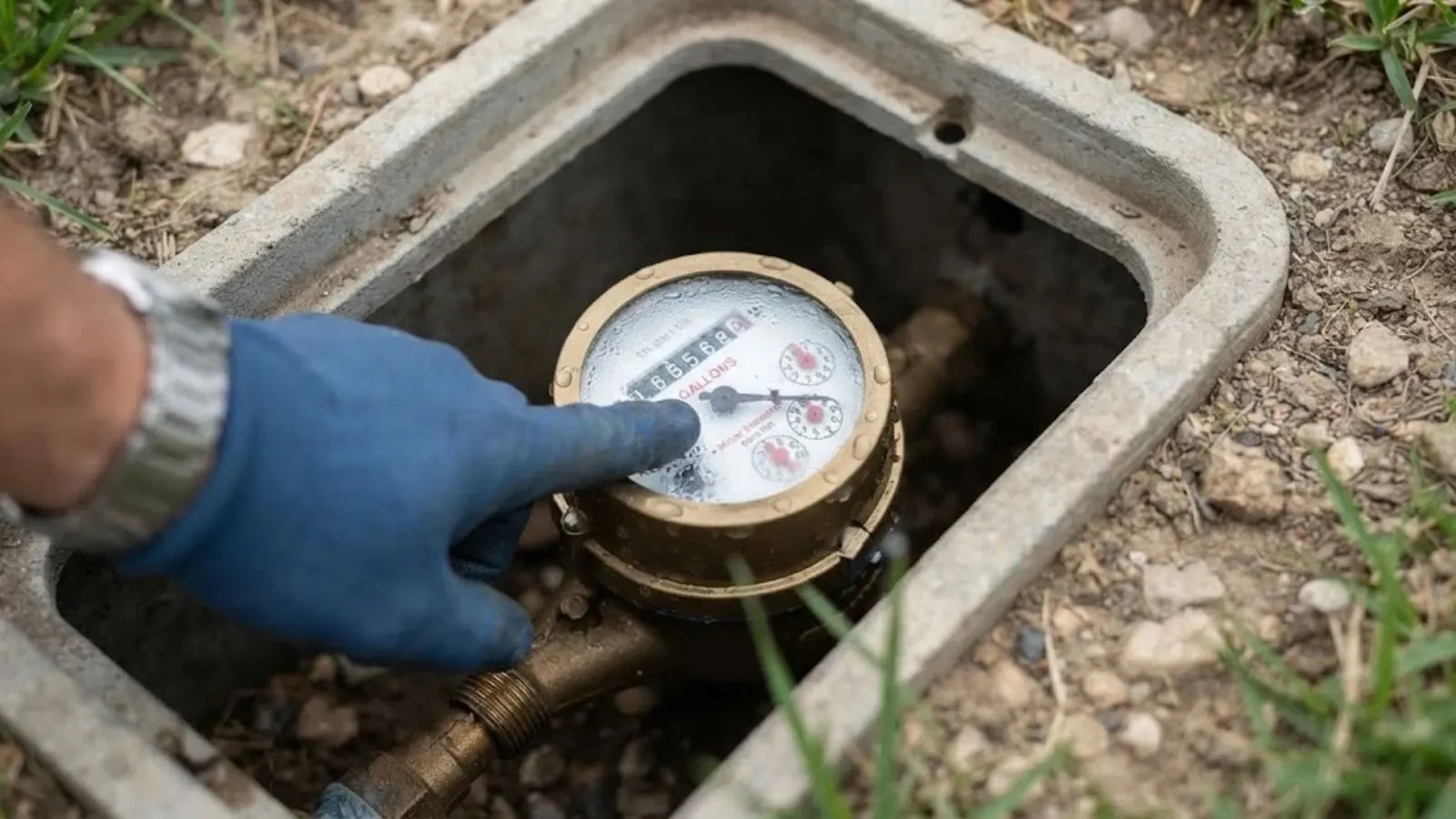
Your water meter is the cheapest leak detector you own. Shut off everything that uses water, watch the meter for 30 minutes, and if the dial or the low-flow indicator is still moving, water is leaving your pipes somewhere. That single test separates a real hidden leak from a bill that is high because of use.
The rest of this guide shows how to find the meter, read it, repeat the test in a way that points to the leak's location, and explain a jump on your bill. It also says where the Town of Brookline's responsibility ends and yours begins, because that line decides who pays for a fix.
Find and read the meter
In most older Brookline homes the meter sits in the basement, close to where the water line enters through the foundation wall. In a multi-unit building it may serve the whole building, which matters for the test below, because every unit has to stop using water for the result to mean anything. The same test works in neighboring Newton and Allston, though utilities there differ.
- Open the lid or look at the face. The register shows a row of digits like an odometer, plus a small dial or triangle that spins when any water moves.
- Note the unit. Meters read in cubic feet or gallons. Your bill may express usage in Ccf, which means hundred cubic feet. One Ccf is 100 cubic feet, or about 748 gallons.
- Write down the full reading. Record every digit, and ignore the fixed zeros printed on the face. Photograph it too, with the time.
- Find the leak indicator. The small star, triangle or red dial turns even with a tiny flow. That is the part you watch.
Meter still spinning?
Close the main valve and call dispatch with the result.
Run a no-water-use test
Set it up when the house is quiet. Turn off the ice maker, the dishwasher, the washing machine and any humidifier. Make sure nobody flushes a toilet. If you have an irrigation system or a water softener that recharges on a timer, switch it off too.
Read the meter, wait 30 minutes with no water use at all, and read it again. Any movement of the leak indicator or any change in the digits is a leak. A slow leak may need an hour or a wait overnight to show on the digits.
Use the shut-off valves to find the zone
Once the meter moves with everything off, shut valves one at a time and watch the indicator.
- Main valve closed. Close the house main, usually next to the meter. If the indicator stops, the leak is inside the house. If it keeps spinning, the leak is between the meter and the valve, which is a short run of pipe worth a look.
- Toilets. Drop a few drops of food coloring in each tank and wait 15 minutes without flushing. Color in the bowl means the flapper is leaking.
- Water heater. Look at the pipe from the pressure relief valve. A steady drip or a wet floor under the tank adds up on the meter.
- Outdoor faucets. A hose bib that drips inside the wall may show nothing outdoors. Look for wet sheathing or a stain on the basement ceiling near it.
What the meter is telling you
| What you see | What it usually means | Next step |
|---|---|---|
| Indicator spins with every fixture off | A leak somewhere in the system | Close the main to learn whether it is inside the house |
| Stops when the main is closed | A leak inside the house | Check toilets, the water heater, then call for leak detection |
| Keeps moving with the main closed | Leak between the meter and the valve | Call a plumber promptly |
| Barely moves, only at night | A slow toilet or fixture leak | Dye test the toilets, then check supply lines |
| Stays still but the bill rose | Higher use, a read mismatch, or a past leak | Compare readings, then call the billing office |
When the leak is outside the house
A reading that spins with the main closed, or a wet patch in a yard or on a basement wall where the line enters, points to the service line. Brookline's FAQ says the homeowner is responsible for the line from the sidewalk shut-off valve to the building, so a break in that stretch is yours to repair.
We cannot see through soil, but acoustic listening gear and a pressure check narrow it to a few feet before anyone digs. When the line itself needs work, our water service line repair team handles the plumbing side, and a licensed contractor handles any excavation in the street.
A running toilet is the most common hidden leak
A toilet with a worn flapper can lose water all day without making a sound. It adds up on the meter and shows as a thin, constant movement of the leak indicator. If the dye test shows color in the bowl, the fix is usually a flapper or fill valve, not a major repair. Our toilet repair visits cover that, and a plumber can confirm whether the rest of the system is tight at the same time.
How to explain a high bill
Compare two readings, not two bills. Take the meter reading from the top of the latest bill, take a current reading, and divide the difference by the number of days. If the daily figure is far above what your household normally uses, check the guest list, the laundry load and the lawn before you suspect a pipe.
If the no-use test showed movement, the extra volume is a leak. Keep the dated photos, your test notes and the repair record. They are the evidence the billing office will want if you ask about leak abatement, which the Town handles.
Who does what on a Brookline water bill
MWRA supplies Brookline's water, and the Town's Department of Public Works Water and Sewer Division runs the local system, per MWRA's 2025 annual water quality report for Brookline. That report also says the Town replaced about 5,200 meters in 2025, so your meter may be new and may have a different register than the one it replaced.
The Town handles water billing. Per the Town's water supply page, the billing office at 617-730-2170 deals with rates, leak abatement and final readings. How often bills arrive is not something we can promise from here, so check your bill for the period it covers or ask the billing office directly.
For a water emergency such as a main leak in the street or a break at the curb, the Town lists a 24/7 emergency line at 617-730-2175. And before any digging on your property, Massachusetts law requires a call to 811 at least 72 hours ahead, not counting weekends and legal holidays.
Water meter and leak questions
Thirty minutes is enough to catch a moderate leak, since the leak indicator moves right away. A slow drip may only show on the digits after an hour or overnight, so repeat the test with a longer gap if the indicator seems still but the bill says otherwise.
Only if every water use is off. An ice maker, a toilet refilling or a washing machine on a timer can move the indicator. Rule those out first, then close the main to see whether the leak is inside the house.
The billing office at 617-730-2170 can tell you your billing period, and your bill should show the dates it covers.
The Town's water page lists leak abatement under its billing office's responsibilities. Whether you qualify, and what documents are needed, is for that office to say. Keep the test notes, the photos and the plumber's repair record.
Yes. Dispatch answers 24/7. If water is running where it should not, close the main valve first, then call (617) 752-0573. Same-day appointments are available when schedules allow for slower leaks.
Per the Town's FAQ, the homeowner is responsible for the service line from the sidewalk shut-off valve to the building. The Town handles the public main. Call the Town's emergency line if water is surfacing in the street.
Found a leak or still guessing?
Call (617) 752-0573 and we will schedule a visit.