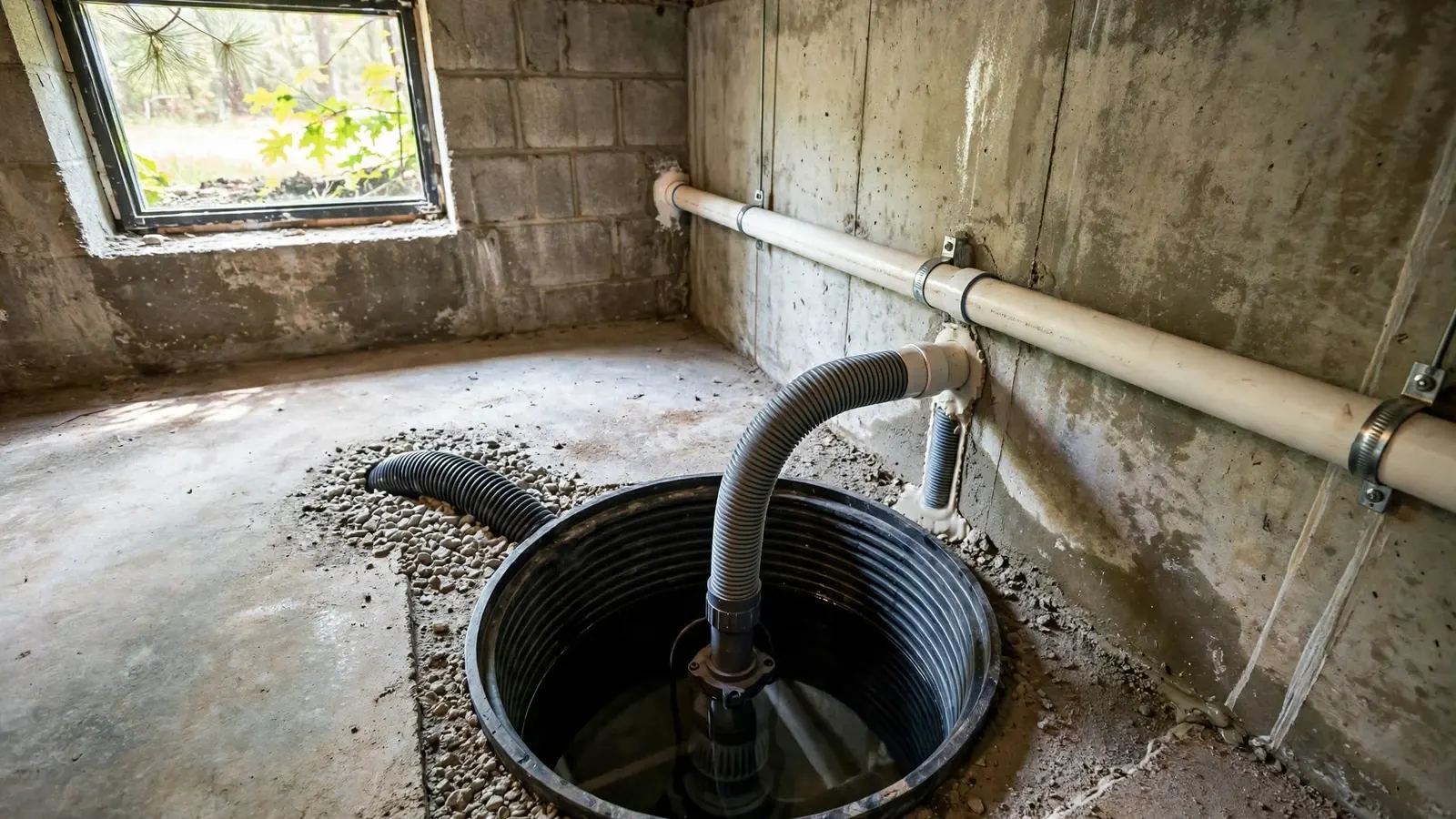
A sump pump battery backup is a second pump, a deep-cycle battery, a charger and a controller that take over when house power fails or the main pump quits. It runs from a battery for several hours of pumping, depending on battery size and how fast water is coming in. The usual setup is a smaller backup pump mounted in the same pit, set a few inches higher than the main one.
Nor'easters and summer thunderstorms often take out power in the same hours that the ground is saturated. That is the exact moment an electric-only pump stops while the pit fills. If your basement has ever shown water at the floor edge, a backup is cheap protection compared with the stuff stored down there. Our sump pump repair work starts with the same question: what happens when the power goes out?
Signs your pit needs a second line of defense
Not every basement needs a backup. These are the situations where we recommend one.
- The pump runs often in storms. If it cycles every minute or two during heavy rain, the pit has little reserve time once power drops.
- You finished the basement. Flooring, drywall and a furnace or water heater on the slab raise the cost of a single failure.
- Outages are common on your street. Overhead lines and tree limbs mean long outages after wind storms.
- The main pump is old. A pump past ten years, with a stuck float or a humming motor, can fail with or without a blackout.
- You are away often. A backup with an alarm only helps if someone hears it, so travel changes the plan.
Want a backup in before the next storm?
Describe your pit and pump on the phone and we will set a visit.
Battery backup versus water-powered backup
There are two common types. They solve the same problem in very different ways, and the right pick depends on your basement and your water supply.
| Feature | Battery backup | Water-powered backup |
|---|---|---|
| Power source | 12-volt deep-cycle battery with a charger | Water pressure from the house supply line |
| Runtime | Hours, set by battery size and inflow | No time limit while supply pressure holds |
| Upkeep | Test monthly, replace the battery every few years | Test monthly, check the valve and fittings |
| Water use | None | Uses drinking water while it runs, so a long storm can raise the water bill |
| Biggest risk | Dead or neglected battery | Low supply pressure, and local rules on backflow protection |
| Best fit | Most homes with a clean pit and an outlet nearby | Homes with strong supply pressure and no wish to maintain a battery |
Water-powered units are not accepted everywhere. Ask the Building Department and your plumber before choosing one.
In practice we lean toward a battery system for most basements. It does not depend on the supply line, and the upkeep is one simple test. If the outage lasts longer than the battery, a generator or a larger battery bank is the next step, and we can talk that through on the phone. If water also seeps through the walls, a pump is only part of the answer, and basement waterproofing is the other half.
What a battery backup installation involves
Most installs take part of a day when the pit is in good shape. The steps below are what a plumber does and what you can expect to see.
- Inspect the pit. We check the liner, depth, debris, and the main pump and float. A pit full of silt gets cleaned first, because a backup pump sitting in grit fails early.
- Size the backup. The backup pump should move enough gallons per minute to keep up with your worst storm, not just match the old pump on a dry day.
- Set the second float. The backup float sits a few inches above the main float so it only starts when the main pump has failed or cannot keep up.
- Run a separate discharge or tie in correctly. A backup needs its own check valve so water pumped by one pump does not fall back through the other.
- Mount the battery and controller. The battery lives in a ventilated box off the floor, with the charger on a working outlet. A dedicated, protected circuit is best, and wiring changes should go to a licensed electrician.
- Test with water. We unplug the main pump, fill the pit and watch the backup start, move water and shut off. Then we show you the alarm and the monthly test.
Discharge: what is allowed and what is not
The backup should send water to the same place as the main pump, usually outside and away from the foundation. It should never be tied into a sanitary drain or toilet line.
Brookline's sewer overflow guidance says that downspouts and sump pumps do not discharge to sewer drains. Clear, rain-driven groundwater in the sewer is one of the reasons the town runs an inflow and infiltration program. If your current pump drains into a floor drain or a sink, tell us before we touch it.
A sump pump is not a sewage ejector
Some basements have a different pit that collects wastewater from a basement bathroom or laundry. That one is a sewage ejector, and it follows different rules. Under 248 CMR 10.15(9), discharge piping from all sewage pumps and ejectors must contain an accessible backwater or check valve and an accessible full port shut off valve.
The same section sets a minimum of 20 gallons per minute for a single-family ejector pump. A backup for an ejector pit is a separate design from a clear water sump backup, so say which pit you have when you call. If you are not sure, the lid and the incoming pipes usually tell us on the first visit.
What the town's own rules mean for your basement
The Census Bureau's 2020 to 2024 American Community Survey puts Brookline's median home build year at 1938. Foundations from that era are often stone or brick with older floors, so a pit may be dug into an uneven slab and a backup may need extra setup time. We look at the floor around the pit before quoting.
Brookline's Building Department states that all plumbing and gas work must be done by licensed individuals, and homeowners cannot pull plumbing permits in town. Per the Massachusetts consumer fact sheet, permits for plumbing work are issued only to licensed plumbers. Your plumber pulls the permit where one is required, so ask us up front.
Brookline Water and Sewer runs a 24/7 emergency line at 617-730-2175 for problems in the public system. A sewer backup in the street is the town's to handle, but groundwater in your pit is yours, which is why the pump and its backup matter.
What a homeowner can do and where to stop
You can test the system, vacuum debris from the pit with the power off, check that the discharge line outside is clear of leaves and ice, and clean battery terminals. Those jobs are safe and worth doing each season.
Stop and call us for anything that changes the plumbing: a new check valve, a new discharge route, a swapped pump or a pit that needs cutting. Stop and call an electrician for new outlets or wiring. Never reach into a pit with a pump plugged in, and never work in standing water with power on.
- Monthly: . pour a bucket of water into the pit, watch both pumps start and the water drop.
- Twice a year: . inspect the battery, tighten terminals and check the charger light.
- Every few years: . replace the battery. A battery that tests fine in September may fail in March.
What moves the price of a backup system
Cost depends on the parts and the pit, not the day of the week. Here is what changes the number.
- Battery sizeA larger deep-cycle battery pumps for more hours and costs more than a compact one.
- Backup pump ratingHigher gallons-per-minute pumps cost more and suit pits that fill quickly in storms.
- Pit conditionA cracked liner, deep silt or a pit that is too small for two pumps adds labor.
- Discharge workA shared line needs a second check valve, and a new route outdoors takes more pipe and time.
- Alarm and monitoringA basic buzzer is simple. Phone-connected alarms add parts and setup.
Some homeowner policies cover water backup only with an added endorsement, and many exclude groundwater seepage. Check your policy before a storm, not after.
Want your real number? Call (617) 752-0573.
Sump pump battery backup questions
It depends on the battery and how hard the pump works. A pump that cycles occasionally can run for many hours, while a pit with constant inflow drains a battery much faster. The battery itself usually needs replacing every few years, so test it on a schedule.
A beep usually means a low battery, a charger that lost power, or a fault in the controller. Check that the charger is plugged in and the outlet works. If it keeps beeping, call us and we will test the battery under load.
Some kits are made for homeowners, but the discharge piping and check valves are plumbing work, and wiring is electrical work. If the install touches the discharge or needs a permit, a licensed plumber should do it. In Brookline homeowners cannot pull plumbing permits.
It avoids battery upkeep, but it uses house water and depends on supply pressure. Rules on backflow protection and approval vary, so ask the Building Department. For most Brookline basements we suggest a battery system.
No. Brookline's sewer overflow guidance states that downspouts and sump pumps do not discharge to sewer drains. Pumped groundwater should go outside, away from the foundation and your neighbor's property.
It buys hours, not days. If outages on your street run long, a bigger battery bank or a generator is the next step. Call and we will go through the options for your pit.
Yes. Brookline borders Allston and Newton, and we dispatch to both. See our Allston plumbing service area and Newton coverage for details.
Keep the basement dry when the lights go out
Call (617) 752-0573 and ask about a battery backup.