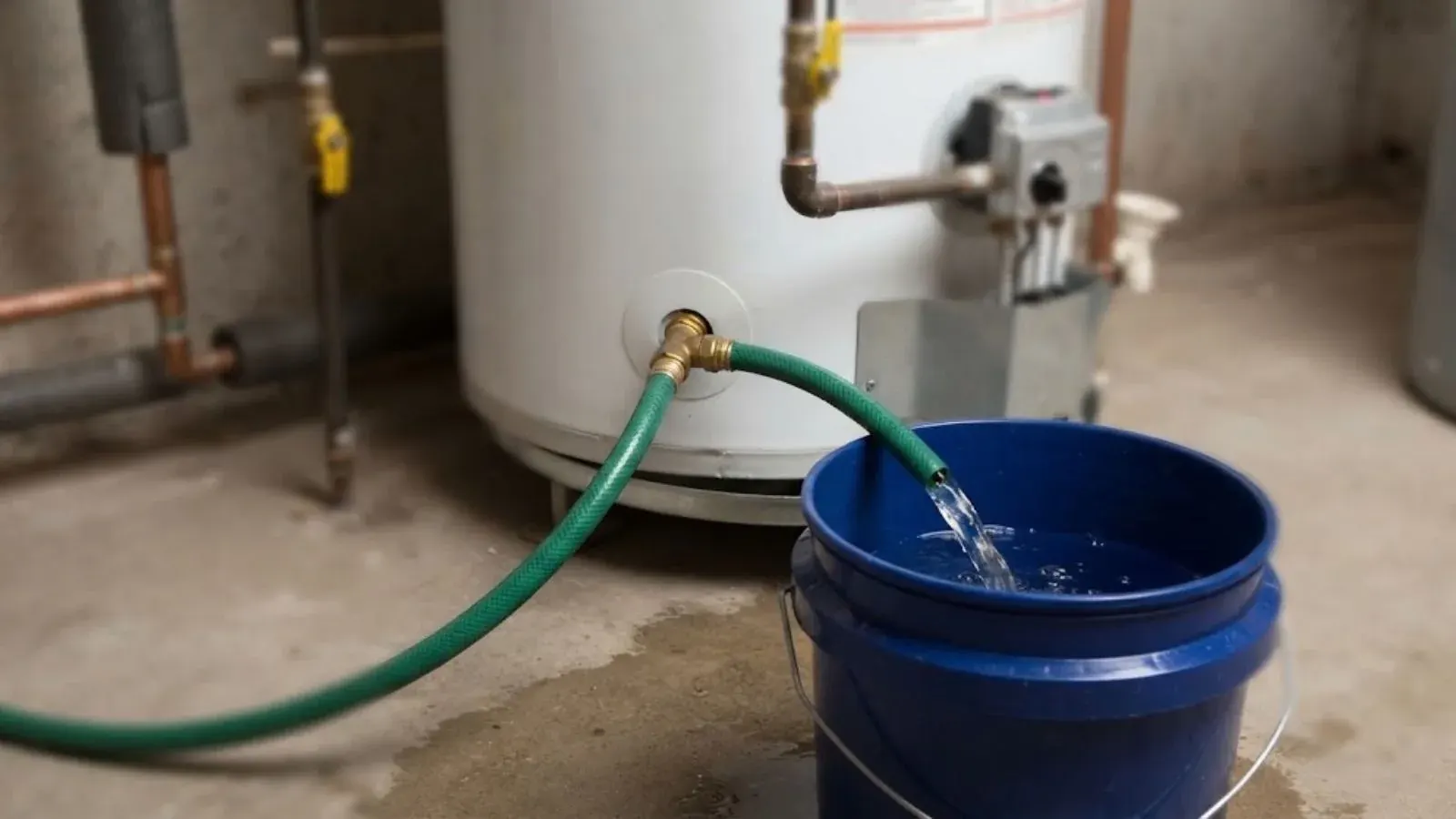
When the hot water stops, our dispatch line answers 24/7 and books same-day appointments when available. Until a technician arrives, leave the gas or breaker alone if anything near the heater is wet, and close the cold supply valve if water is escaping.
This page is about water heater repair in Brookline, MA: no hot water, pilot and igniter trouble, bad thermostats, dripping relief valves and sediment. Some failures mean the tank is done, and then our water heater replacement page is the better read.
No hot water: what usually went wrong
A heater that goes cold overnight has a short list of likely causes, and the fuel type narrows it fast.
- Gas, no flame. A pilot that blew out, a dirty thermocouple or a failed igniter on an electronic-ignition unit.
- Electric, lukewarm or cold. A burned-out heating element or a tripped high-limit switch.
- Hot at first, then cold. A cracked dip tube sends cold water to the outlet and mixes it with the hot.
- Rumbling, popping or whining. Sediment on the bottom of the tank is boiling under the burner or element.
- A flashing code on the control. Newer units report faults, and the code points to the part to test.
Pilot out for the second time?
That is a failing part, not bad luck. Call and describe the symptoms.
How we find the failed part
- Look and listen. We check the tank, fittings and pan for moisture, then the flue, burner and wiring for scorch marks or loose connections.
- Test with a meter. A multimeter checks elements, thermostats and the high-limit switch on electric units, and the thermocouple output on gas units.
- Check temperature and pressure. A thermometer at a hot tap and a pressure gauge on a hose bib show whether the setting and the house pressure are in range.
- Judge the tank. We tap the shell, look at the age on the data plate and inspect the drain-down water for rust, so you know if a repair is worth paying for.
Massachusetts code lists 120 degrees Fahrenheit as the minimum and 130 as the maximum for residential hot water, so we adjust thermostats inside that range.
Repair options and what they cost you in time
| Problem | Repair | Worth it? |
|---|---|---|
| Pilot keeps going out | Clean or replace the thermocouple or igniter | Yes on most tanks under 12 years |
| Electric tank runs lukewarm | Replace the upper or lower element | Yes, quick and low cost |
| Water too hot or too cool | Replace or reset the thermostat | Yes |
| Dripping from the relief valve | Replace the valve and check house pressure | Yes, but find the cause first |
| Leak at a fitting or drain valve | Replace the fitting or valve | Yes if the tank is dry |
| Leak from the tank shell | Replacement only | No, repair will not hold |
We tell you which column your heater lands in before any part is ordered.
The relief valve that keeps dripping
Every tank carries a temperature and pressure relief valve, and 248 CMR requires its discharge pipe to be full size, with no shut-off, ending within twelve inches of the floor. A valve that opens occasionally is doing its job, and a valve that drips all the time has either worn out or is reacting to excess pressure.
A check valve is not allowed on the cold supply to a heater, but a meter or backflow device elsewhere in the house can create the same closed system. In that case the code calls for a properly sized thermal expansion tank, and adding one often ends the drip. Never cap the discharge pipe, because that disables the safety device.
If your heater is working and the valve is simply weeping, our water heater installation page explains how we size and place expansion tanks on new work.
Anode rods, sediment and soft water
The anode rod is a sacrificial metal stick that corrodes so the tank does not. Swapping a spent rod on a tank that is otherwise sound can add years, and we will tell you if the tank is already too far gone for the rod to matter.
Brookline's water is soft, about 1 grain per gallon in MWRA's monthly report, so scale is slower to build than in hard-water towns. Sediment still accumulates, and a periodic flush through the drain valve removes it.
Leak or no heat at the heater: what to do first
Shut the cold supply
If water is escaping from the tank or a fitting, close the valve on the cold pipe above the heater.
Do not relight a stuck pilot
If the unit has locked out more than once, repeated relighting only wastes time. Note any code on the display for the technician.
Gas smell means leave
If you smell gas, leave the building and call 911 or National Grid at 1-800-233-5325 before calling us.
Dry the area
Mop standing water and move stored items off the floor, especially cardboard, so we can see the source of the leak.
Why heater calls come from every kind of Brookline building
Over half of Brookline's housing units are rentals, and three quarters sit in buildings with two or more units, per Census ACS figures. In a triple-decker or condo, a leaking heater in a shared basement can soak the unit below, so we ask early about who holds the key and where the shut-offs are.
We also take heater calls from Newton and the neighboring Boston neighborhoods, so the dispatcher can tell you honestly what the day looks like.
What drives the cost of a heater repair
- The failed partAn igniter, a thermostat and an element cost different amounts, and a valve differs from a dip tube.
- Age of the tankPutting a new part into a 15 year old tank is a different decision than fixing a 5 year old one.
- Fuel typeGas work involves the burner assembly and venting checks, while electric work centers on the elements and wiring.
- Time of dayA call in the middle of the night is different from a same-day daytime visit.
- AccessA heater tucked behind a boiler or in a tight closet takes longer to reach.
Repair costs for wear and tear are normally not covered by a homeowner policy. Water damage from a sudden leak sometimes is, so keep photos.
Want your real number? Call (617) 752-0573.
Water heater repair questions
Yes. Dispatch is open 24/7 and we book same-day appointments when available, including after hours. Tell the dispatcher whether water is escaping so we can prioritize the call.
On a gas heater the pilot or igniter is the first suspect. On an electric tank, a burned element or a tripped high-limit switch is more likely. A technician can tell which in a few minutes with a meter.
Once, following the label on the unit, if there is no gas smell. If it goes out again, the thermocouple or gas valve is failing and it needs service. If you smell gas at any time, leave and call 911 or National Grid at 1-800-233-5325.
Often, when the problem is a part and the tank is dry inside. A leaking shell or rust in the drain water points to replacement, and we will explain that before ordering anything.
Electric work on the heater means shutting off the breaker and testing it dead first, and plumbing work in Brookline requires a licensed plumber and a permit. We recommend calling us, and if the unit is gas, never do the work yourself.
Massachusetts code lists a range of 120 to 130 degrees Fahrenheit for residential hot water. We check it at a tap with a thermometer and not by the dial alone.
Cold water and a technician on the way
Dispatch answers all night. Call (617) 752-0573 to book the next opening.