Waterproofing paint is a thick masonry coating, usually cement-based or acrylic, rolled or brushed onto bare concrete, block or brick. It can slow dampness that comes through the wall as vapor or a light seep. It cannot hold back water that is pushing against the foundation, and in many older basements that is the problem.
So the useful question is not whether paint works. It is what kind of water you have. A damp patch that dries out in a dry week is a paint job. A wall that weeps after every rain, a floor crack that wets the slab, or white crust that comes back each spring points to drainage, and a coating on top will fail within a season or two.
Hydrostatic pressure is what paint cannot beat
When soil around a foundation soaks up rain or snowmelt, the water has nowhere to go but down and sideways. It presses on the wall and floor. Each foot of water depth against a wall pushes with about 560 pounds of force on every square yard.
Masonry paint is applied to the inside face and held on by bond to the wall. Pressure from behind lifts it off in blisters, then flakes. The water then finds the next weak spot, usually a mortar joint or the joint where the wall meets the floor.
Not sure paint will hold?
Describe the wall and when it gets wet, and we will tell you straight.
Paint versus real waterproofing
These are different tools for different problems. Mixing them up is how people repaint the same wall three times.
| Approach | Good for | Not good for |
|---|---|---|
| Masonry waterproofing paint | Damp walls, light vapor, sealing a dry wall before finishing | Leaks under pressure, floor cracks, standing water |
| Crack and joint repair | A single leaking crack or open mortar joint | Water coming from many places at once |
| Interior perimeter drain with sump pit | Groundwater that rises under or beside the slab | Roof or gutter water that never leaves the wall |
| Exterior drainage and downspout fixes | Surface water flowing toward the foundation | Rising groundwater alone |
| Sump pump | Collecting and moving water out of the pit | Sealing wall surfaces |
A real fix often combines two of these.
A simple test before you buy a bucket of paint
Tape a two-foot square of clear plastic to the bare wall, seal all four edges and wait two days. Where the moisture shows up tells you what you are fighting.
- Droplets on the room side of the plastic: the room air is humid. Run a dehumidifier and vent the dryer outside. Paint is not the answer.
- Droplets under the plastic against the wall: moisture is moving through the wall. A masonry coating may help if it is a light seep.
- Wet wall after rain, or water at the floor edge: this is groundwater or surface water under pressure. Skip the paint and look at drainage.
- White powder on the wall: that is efflorescence, mineral salt left behind by water moving through. It tells you water is passing through, so address its source.
What a coating faces in an old Brookline foundation
Stone, brick and early block foundations have uneven faces, soft mortar and old paint layers. Paint does not bond well to crumbling mortar, and it will not bridge gaps. A wall that has been limewashed or painted with oil-based coatings has to be wire-brushed and cleaned before any masonry paint sticks.
Many of these basements also have floors poured long after the walls, so the cold joint at the base of the wall is the common leak path. No paint seals a moving joint. That joint needs drainage or a flexible repair.
How to apply waterproofing paint properly
If your test says the wall is only damp, a coating can be a sensible, low-cost step. Doing it right matters more than the brand.
- Strip and clean. Remove old paint, loose mortar and efflorescence with a wire brush. Rinse and let the wall dry fully.
- Patch holes and cracks. Use hydraulic cement for active seepage in a crack, which sets in minutes even on a wet surface.
- Dampen the surface if the product calls for it. Many cement-based coatings cure better on a damp, not wet, wall. Read the label.
- Apply two coats. Work a stiff brush into the pores of the masonry, then wait for the cure time between coats.
- Watch it through a wet season. If blisters appear, stop. The water is under pressure and paint will not hold.
A coating is not a vapor barrier for a finished room. If you plan to build out the basement, fix the water first, then frame.
When drainage or a sump is the answer
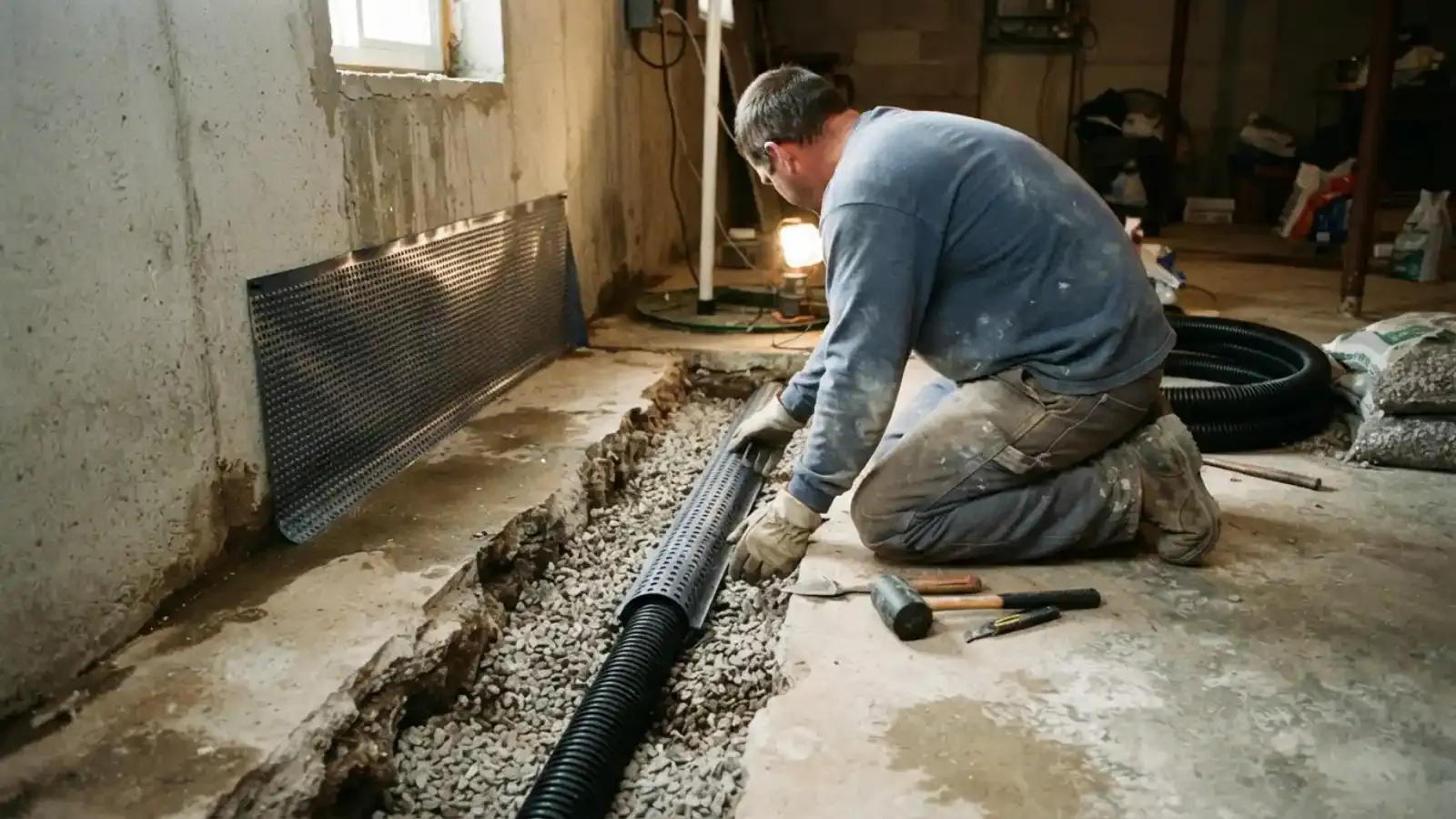
If water shows up at the floor edge, through the slab or after every storm, the answer is to give it a path out. That is usually an interior drain along the footing that leads to a sump pit, and a pump that sends the water outside. Our basement waterproofing work starts with finding where the water enters before anything is closed up.
The pump is the part that fails, so size it and back it up. Our sump pump repair visits often find a pump with a stuck float or a pit full of silt. A wet basement with a dead pump is a plumbing call before it is a paint question.
What is DIY and what to hand off
Cleaning, patching with hydraulic cement and painting are homeowner jobs. Moving gutters and extending downspouts away from the wall is also a good first step, and often the cheapest.
Anything that connects to the drain system, adds a pump or cuts the floor is plumbing work. Brookline does not let homeowners pull plumbing permits, so a licensed plumber must handle those. Also stop if you see a wall bowing inward, stair-step cracks wider than a pencil, or water near electrical panels. Call a structural pro or an electrician before anything else.
Why many Brookline basements stay damp
Per the Census Bureau's American Community Survey for 2020 to 2024, the median home in Brookline was built in 1938, and 51.7 percent of the town's housing units were built in 1939 or earlier. Older masonry, older drains and older slabs all leak in ways a coating will not fix.
The National Weather Service recorded the Muddy River at its Brookline gauge cresting at 15.41 feet in the March 2010 floods, against a flood stage of 15.0 feet. That is a reminder that groundwater near the Muddy River can run high after sustained rain, and a basement near it should be judged by drainage, not by paint.
Brookline's sewer overflow guidance states that downspouts and sump pumps do not discharge to sewer drains. So any pit and pump we install sends water outside, and your gutters and downspouts do the same.
What moves the cost of a dry basement
Paint is a small material cost, while drainage and pump work is a plumbing job with several variables. Here is what changes the number.
- Where water entersOne wall seep costs far less to solve than water along an entire footing.
- Floor conditionCutting a trench for an interior drain depends on slab thickness and what is under it.
- Pump and pitThe pump rating, a battery backup and whether a pit already exists shape the total.
- Discharge routePumped water needs a clear path outside, away from the foundation.
- Finish levelA basement with new flooring and framing needs more protection and more careful access.
Many homeowner policies exclude groundwater seepage. Ask your insurer what yours covers before you plan a repair.
Want your real number? Call (617) 752-0573.
Basement paint and waterproofing questions
Floor coatings can help with dampness from the slab, but they do not stop water that rises through cracks under pressure. If water pools on the floor after rain, you need drainage and a pump, not paint.
Not safely. Brush it off, rinse, let the wall dry and find out why water is moving through it. Painting over it traps the salts, and the coating will peel.
Not by itself. A leaking crack needs a patch made for active water, such as hydraulic cement, or an injection repair. Paint can follow after the crack has stayed dry.
On a wall with only light dampness it can last for years. On a wall under pressure it often blisters within one or two wet seasons. How soon it fails tells you the water is real.
If water collects at the floor edge or the slab, yes. The pit and pump handle water that paint cannot hold back.
Plumbing permits in Brookline are issued only to licensed plumbers, and homeowners cannot pull them. Your plumber pulls the permit where one is required. The Building Department can confirm if you have questions.
Yes. We dispatch from Brookline to both. See our Jamaica Plain service area and Brighton coverage.
Fix the water, then the wall
Call (617) 752-0573 to talk through drainage and pump options.