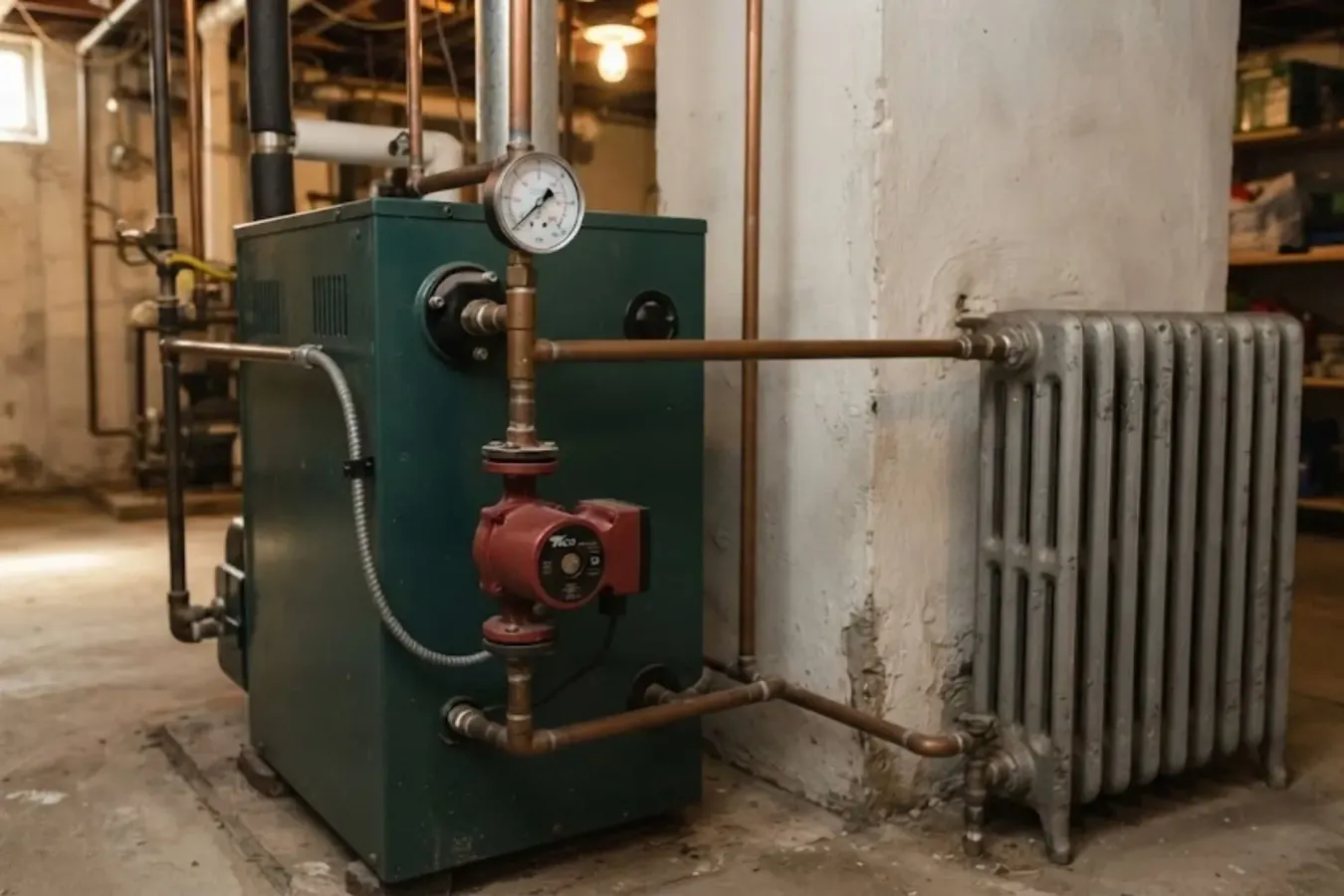
A cracked boiler section or heat exchanger can leak water, let combustion gases into the room, or both. Treat it as a safety problem before it is a comfort problem. If you smell gas, leave the building and call 911 or National Grid at 1-800-233-5325 before calling us. If a carbon monoxide alarm sounds, get everyone outside into fresh air and call 911.
Once the building is safe, the question is whether the crack can be repaired or whether the boiler has to be replaced. In most cases a cracked iron section or a cracked steel heat exchanger means replacement, though a few situations leave room for a repair. This guide explains how that decision works and what you can and cannot do yourself, which is nothing.
What to do right now if you suspect a crack
Do these in order and do not try to finish the job yourself.
- Gas smell. Leave the building at once. Do not flip switches or use a phone inside. Call 911 or National Grid at 1-800-233-5325 from outside.
- Carbon monoxide alarm. Get everyone, pets included, into fresh air and call 911. Do not go back in to silence the alarm.
- Dizziness, headache or nausea at home. These can be early carbon monoxide symptoms. Leave and call 911.
- Water leaking from the boiler. Turn off the boiler's power switch and the fuel supply if you can reach them safely, then call dispatch.
- Do not run it. A cracked boiler should stay off until a licensed technician has looked at it. No tape, putty or sealant is a repair.
Boiler leaking or smelling wrong?
Shut it off, get safe, then call dispatch.
How a cracked boiler shows itself
Water pooling under the boiler or running down between sections is the most visible sign. Others are soot on the boiler or around the burner, a flame that looks yellow and lazy instead of crisp and blue, a pilot that will not stay lit and a pressure gauge that keeps dropping so the boiler needs constant refilling. We service systems for customers in Newton and Brighton as well.
A rumbling or kettling noise can also point to scale or a damaged exchanger. None of these alone proves a crack. They are reasons to shut it down and have a technician test it with a combustion analyzer and a pressure test.
Why boilers crack
Cast iron sections crack from thermal shock, when cold water hits a hot boiler or when the system is refilled after a low water condition. Freezing can also split a section when a building loses heat in winter. Steel and aluminum heat exchangers in newer boilers fail by corrosion, scale or overheating when circulation is poor.
Age and poor water treatment add to it. Boilers that are fed fresh water constantly through a leak build up mineral scale and corrode faster, so a small leak that goes untreated can turn into a cracked section.
Repair or replace a cracked boiler
Our boiler repair team tests the unit and tells you what the boiler can and cannot do. If the answer is replacement, plumbing installation covers the new unit and its piping, and your licensed plumber pulls the permit.
| Situation | Usual answer | Why |
|---|---|---|
| Cracked steel or aluminum heat exchanger | Replace the boiler | The exchanger is not a serviceable part on most units |
| One cracked cast iron section on a sectional boiler | Sometimes a section can be swapped, often replace | Sections are old, parts can be hard to find, and neighboring sections are often near failure |
| Small leak at a push nipple or gasket | Repair | This is a seal failure, not a crack |
| Crack from a freeze event | Test and often replace | Other sections may be damaged |
| Boiler near the end of its life | Replace | A repair buys little time |
Only a technician with the boiler open can say which row you are in.
Steam versus hot water in older buildings
Steam systems heat water to boiling and push steam up to radiators, which then return condensate to the boiler. Hot water systems pump heated water through a loop. A crack in a steam boiler tends to show as constant makeup water and wet returns, and in a hot water boiler as a falling pressure gauge.
Many buildings put up before 1940 were first heated by steam or gravity hot water, and Brookline's median year built is 1938. If your building has cast iron radiators with one pipe and a valve on each, it is probably steam. Swapping a steam boiler for a hot water boiler means changing the whole radiator system, so the choice is not like for like.
Why this is not a DIY repair
Sealing products and welding repairs on a cracked boiler can hide a failure until it releases combustion gas or scalding water. Gas, flue and permit work all require licensed professionals in Massachusetts, and homeowners cannot pull plumbing or gas permits in Brookline.
If the boiler is out and you need heat today, ask dispatch about options. Do not use a gas oven or an unvented space heater to warm a living space, since both can produce carbon monoxide.
Heating rules and housing that affect a boiler failure
Under the state's heating season guidance (105 CMR 410.201), the season runs from September 15 through June 15. Habitable rooms and bathrooms must reach 68 degrees from 7:00 a.m. to 11:00 p.m. and 64 degrees from 11:01 p.m. to 6:59 a.m. Boards of Health may vary the dates. A cracked boiler that cannot be fired during those months can leave a unit below those minimums, so call quickly.
Census ACS data for 2020 to 2024 show that 53.2 percent of occupied Brookline units are rented and that the median year built is 1938. In rental buildings, tenants should tell the owner right away, and owners should treat a shut-down boiler as urgent.
For gas emergencies, National Grid lists 911 or 1-800-233-5325 around the clock. If you are unsure who supplies your gas, call 911 first.
Cracked boiler questions
Sometimes, when the failed part is a seal, a gasket or one replaceable cast iron section. A cracked steel or aluminum heat exchanger usually means replacement. A technician has to test the boiler to know which applies.
It can be. A cracked heat exchanger may let combustion gases, including carbon monoxide, enter the room, and a cracked section can leak hot water. Turn the boiler off and keep a working carbon monoxide alarm on every level.
Look for a sight glass showing a water level and a low-pressure gauge. A steam boiler has both. A hot water boiler has a pressure and temperature gauge and a circulator pump. A technician can confirm it in a minute.
The state heating season is September 15 through June 15, with minimum temperatures of 68 degrees in the day and 64 at night. Call dispatch so we can schedule a technician. Tenants should also tell their landlord.
Yes. Dispatch answers 24/7. If there is a gas smell, leave and call 911 or National Grid first. For a leaking boiler with no gas smell, turn off its power and call (617) 752-0573. Same-day appointments are available when schedules allow.
A licensed professional. The Building Department states that plumbing and gas work must be done by licensed individuals and homeowners cannot pull those permits. Ask any contractor for their license before work begins.
Need a technician to test the boiler?
Call (617) 752-0573 and we will plan the visit.