An infrared camera finds some water leaks and misses others. It shows differences in surface temperature, and a wet wall or floor is often a different temperature from a dry one. That makes it good at pointing to where to look, and unreliable as proof of a leak on its own.
In practice, a plumber uses it as the first step, then confirms with a moisture meter, listening gear or a pressure test. This guide explains each tool, where thermal imaging misleads in older plaster and radiator buildings, and what you can do before anyone arrives.
What the camera actually sees
A thermal camera reads infrared energy from a surface and paints it as a color map, warm in one color and cool in another. It cannot look through drywall, plaster or tile. It only sees the surface temperature of what is in front of it. We run the same scans for customers in nearby Brighton and Jamaica Plain.
Water changes that surface in two ways. A hot water line leaking into a wall warms the spot. Evaporating moisture cools it. The camera picks up either pattern when the temperature difference is large enough, usually a few degrees, and when the surface is not covered by something that insulates it.
Wall damp and source unknown?
Describe the stain to dispatch and we will plan the scan.
When thermal imaging finds a leak
Conditions that favor a clear image:
- Hot water lines. A leak on a hot supply or a heating loop leaves a warm trail inside a cool wall.
- Radiant heat floors. A leaking tube under a floor shows as an irregular warm patch.
- Fresh, active wetness. A ceiling stain below an upstairs bath often shows a cool, damp patch as the water evaporates.
- Roof or window leaks. Wet insulation holds a different temperature from dry insulation around it.
- Large, thin-walled surfaces. Drywall and thin plaster let surface changes show more clearly than thick masonry.
When thermal imaging misleads
A cool patch on a wall can be a leak, or it can be a missing stud bay, a cold exterior corner or a draft. A warm spot can be a hot pipe doing its job, not a leak. The camera cannot tell you which without more information.
It also struggles with deep leaks under a slab, behind metal or tile, and in old thick masonry that evens out surface temperature. A dry, old leak leaves no thermal trace at all. That is why a good operator always confirms with a second method before opening a wall.
Plaster, radiators and steam in older Brookline buildings
Plaster over wood lath is thick, and it holds heat unevenly. A radiator pipe in the same wall heats a stripe of the surface even when nothing is leaking, so the image can look like a leak when it is just a heating pipe.
Heating season matters here. Under the state's guidance, the season runs from September 15 to June 15, and during those months radiator and boiler piping is warm on purpose. We often scan in the off season or with the heat set back so the camera can tell a leak from a pipe doing its normal work. If we suspect the boiler loop itself, our boiler repair team can pressure-test it.
What confirms the camera's guess
The order matters. A moisture meter on the spot the camera flagged tells you whether the wall is wet. Acoustic gear or a pressure test tells you whether a pressurized pipe is leaking. Our leak detection visits combine these so the wall is opened in the right place, once.
| Tool | What it does | Weak spot |
|---|---|---|
| Thermal camera | Maps surface temperature to spot warm or cool patches | Cannot see inside walls, can mistake pipes and drafts for leaks |
| Moisture meter | Reads moisture in drywall, wood or plaster by pin or pad contact | Reads only the spot it touches and can be thrown off by metal |
| Acoustic listening gear | Picks up the hiss of pressurized water in a pipe | Needs quiet and works best on pressurized lines |
| Pressure test | Isolates a line and watches for a drop | Says a leak exists, not where |
| Tracer gas | A harmless gas mix added to a line shows where it escapes | Takes setup and works best where air can reach the surface |
| Camera on a cable | Looks inside drain pipes | Does not find supply leaks |
What you can do while you wait
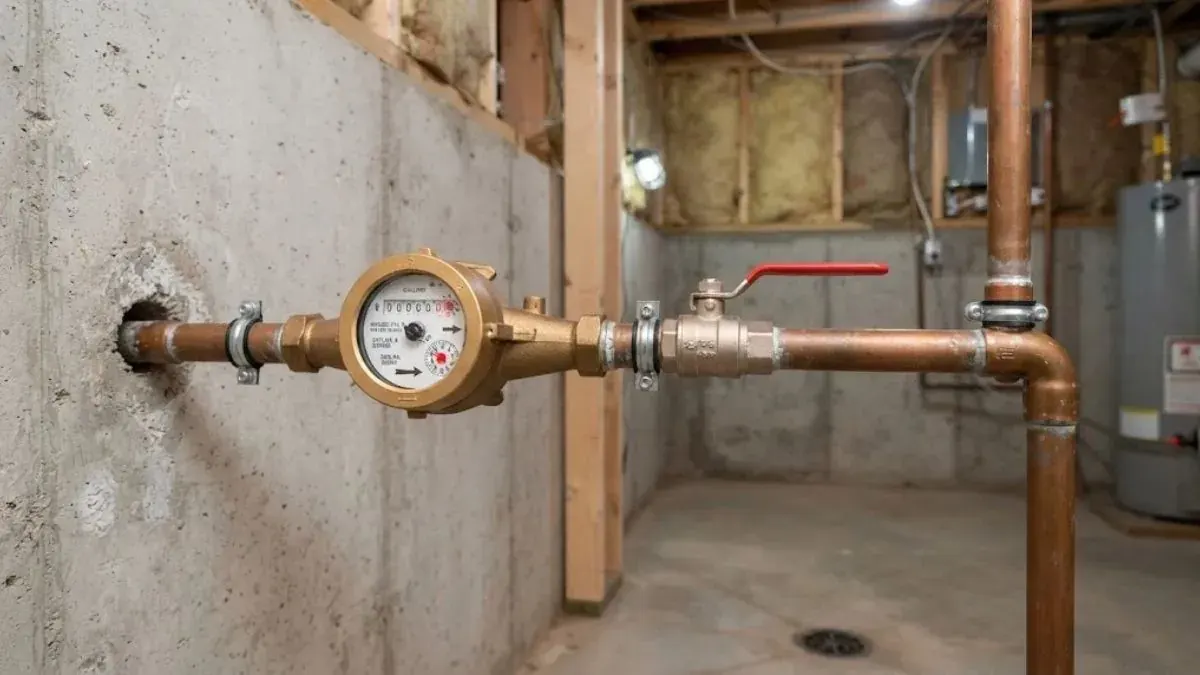
- Check the water meter. With everything off, a moving meter confirms a leak somewhere. If it stops, the problem is probably a drain or a roof.
- Photograph the stain. Take a dated photo now and another tomorrow. A growing stain means active leakage.
- Keep the heat steady. Do not turn the heat up or down sharply just before the scan. A stable surface temperature gives a cleaner image.
- Clear the area. Move furniture and take down anything covering the wall or floor in question.
- Shut the water off if it is pouring. Close the main valve and call dispatch right away. A burst pipe needs burst pipe repair and not a scan.
Why older Brookline buildings are harder to scan
Census ACS data for 2020 to 2024 show that 65.0 percent of Brookline's housing units were built before 1960, and the median year built is 1938. That means many walls are plaster over lath and many heating systems are older, which both complicate a thermal scan.
The same data show that 76.5 percent of units are in buildings with two or more units. In those buildings a stain on your ceiling may come from the unit above, so the camera visit often needs access upstairs and a talk with neighbors or the building owner.
On the heating side, the state's sanitary code guidance sets minimums of 68 degrees from 7:00 a.m. to 11:00 p.m. and 64 degrees overnight, from September 15 through June 15. Boards of Health may vary the dates. Keep the heat at those levels during a scan, since that is when radiators are warm.
Thermal leak detection questions
Not directly. It sees the surface temperature of the wall, and a leak behind it can change that temperature. A second tool, such as a moisture meter, confirms whether there is water behind the surface.
Cold spots come from drafts, missing insulation and cold exterior corners as often as from water. That is why a moisture reading comes next. If the wall reads dry, the cold spot is not a leak.
Sometimes, if the leak is on a hot line and the floor surface is thin. A deep leak in a concrete slab usually needs acoustic listening or a pressure test. The camera is a starting point, not the answer.
It can be. A warm pipe makes a stripe on the image that looks like a leak. We note where the heating pipes run, and where possible scan with the heat set back so the stripe fades.
Yes. Dispatch answers 24/7. If water is running into a ceiling or floor, close the main valve, stay clear of wet electrical areas and call (617) 752-0573. Same-day appointments are available when schedules allow.
For a water emergency in the public system, the Town's Water and Sewer Division lists a 24/7 line at 617-730-2175. For a leak inside a multi-unit building, start with the building owner and have a plumber document the source.
Want it found before it is opened?
Call (617) 752-0573 to schedule a leak visit.