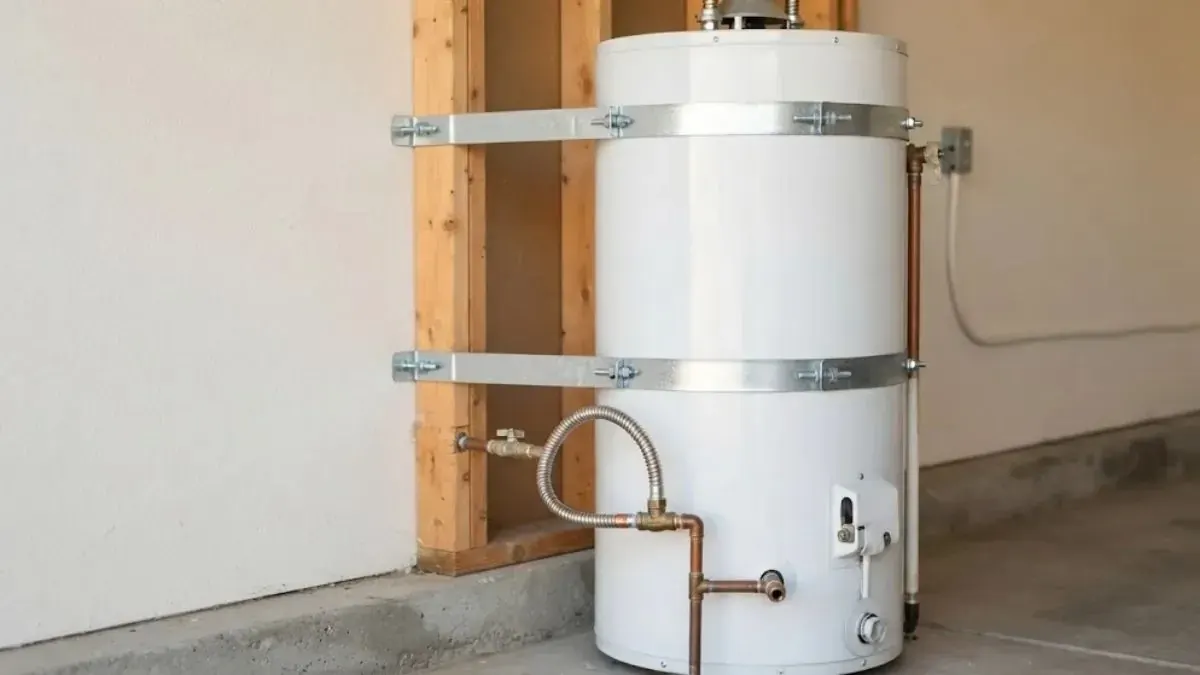
A thermal expansion tank is a small steel tank with a rubber diaphragm, usually a few gallons in size, that hangs on the cold supply line near the water heater. When water heats it expands, and in a closed plumbing system that extra volume has nowhere to go. The tank's air cushion absorbs it so pressure does not spike.
Replacing one is a short job for a plumber, but it is not a casual do-it-yourself swap. In Brookline, plumbing permits are issued only to licensed plumbers, and the tank must be sized and charged correctly. This guide covers the signs of a failed tank, what you can safely check, and what the replacement involves.
How to tell the expansion tank has gone bad
A failed tank rarely announces itself. These are the common clues.
- The relief valve drips or spits. The temperature and pressure valve on the heater opens briefly when pressure climbs with nothing to absorb it.
- Pipes bang when a fixture shuts. Pressure spikes show up as thumps in the walls, and a waterlogged tank cannot cushion them.
- The tank feels full of water. Tap it. A healthy tank sounds hollow on top and solid at the bottom. A tank that is solid all the way down has lost its air cushion.
- Water comes out of the air valve. Pressing the small valve stem on the tank should release air only. Water means the diaphragm has ruptured.
- Rust or a seep at the tank seam. Corrosion on a steel tank body means the end is near, even if it still holds air.
Relief valve dripping again?
Tell dispatch what you see and we will check the tank and pressure.
Where the code says a tank is needed
Massachusetts plumbing code, 248 CMR 10.14, says that a properly sized thermal expansion tank may be installed to prevent excessive pressure. It also says that when a metering device with a check valve or backflow preventer is installed, creating a closed system, a properly sized thermal expansion tank shall be installed.
That second case is the common one. A check valve or backflow device on the supply stops expanded water from pushing back into the main, so the tank takes over that job. The same section bars a check valve in the cold line to a hot water heater. That rule is why a plumber must look at the whole supply layout, not only the tank.
What a homeowner can check before calling
You can learn a lot without opening any pipe. These checks are safe if you stay on the outside of the system.
- Find the tank. It sits on a tee in the cold line above or beside the heater, often hanging from the pipe. Note its size and age from the label.
- Tap it. Compare the top and bottom by sound. Solid all over means waterlogged.
- Look at the relief valve discharge pipe. The code calls for a full-size discharge pipe with no shut-off, ending at a fixture or within twelve inches of the floor. Drips there are a warning.
- Check your supply pressure with a gauge. A hose-bib gauge shows static pressure. Readings that climb well past normal while the heater fires point to thermal expansion.
- Stop there. Do not cap, plug or adjust the relief valve, and do not close the heater's cold supply unless you are shutting the heater down for a leak.
Why a licensed plumber should do the swap
Under Massachusetts rules, a permit is needed to install, alter, remove, replace or repair plumbing work, and permits are issued only to licensed plumbers. Brookline's Building Department states that homeowners cannot pull plumbing or gas permits in town, and review takes about three days.
An expansion tank also has to be sized to the heater volume and the house pressure, then charged with air to match that pressure before it goes on. Tanks installed uncharged or oversized fail early and let the relief valve keep dripping. That is the reason we send a licensed plumber rather than offer a how-to for your own wrench.
What the replacement visit looks like
A typical visit is quick when the access is clear. Here is how it runs on our side.
- Diagnose. We read the pressure, test the old tank and check the relief valve and discharge pipe.
- Shut down and drain. We isolate the heater, relieve pressure and lower the water level in the line.
- Swap and support. A new tank goes on with proper fittings and a hanger or stand. A heavy tank should not hang from a copper stub alone.
- Charge to match. We set the tank's air precharge to the house pressure before opening the line.
- Restart and test. We bring the heater back up, watch the pressure rise and confirm the relief valve stays quiet.
If a failed tank is a sign of a bigger problem, such as a heater near the end of its life or a pressure reducing valve that drifted, we say so. Our water heater repair visits often start here, and a worn heater may lead to a new water heater installation where the tank is added on the way.
What each symptom usually means
| What you see | Likely cause | Who handles it |
|---|---|---|
| Tank sounds solid top to bottom | Air cushion lost, diaphragm failed | Licensed plumber |
| Water from the tank's air valve | Ruptured diaphragm | Licensed plumber |
| Relief valve drips after each heating cycle | No cushion, or supply pressure too high | Licensed plumber |
| Hammering when a faucet or washer shuts | Pressure spike, sometimes a worn tank | Licensed plumber |
| Tank seam rusted or weeping | Shell corroded through | Licensed plumber |
Only the tapping test and the pressure gauge reading are yours to do.
Brookline rules that touch your water heater
MWRA supplies Brookline's water, and the Town's Water and Sewer Division runs the local system under state rule 310 CMR 22.22, which includes a cross-connection and backflow program. Backflow devices are one way a house becomes a closed system, and a closed system is where the code calls for an expansion tank. The Town's 2025 water quality report states that it operates under that regulation.
The code table in 248 CMR 10.00 puts residential hot water temperature between 120 and 130 degrees Fahrenheit. If your relief valve drips and your heater is set above that, a plumber can lower the setting while checking the tank.
Brookline's Building Department issues plumbing permits through its Accela online portal, and only to licensed plumbers. Your plumber pulls the permit where one is required. If you smell gas near the heater, leave the building and call 911 or National Grid at 1-800-233-5325 before calling us.
What affects the cost of a new expansion tank
The tank itself is a small part of the job. The rest depends on your setup.
- Tank sizeA larger heater needs a larger tank, which costs more than a standard small one.
- AccessTight utility closets and low ceilings take longer than an open basement.
- Supply conditionCorroded fittings or a failing shut-off valve add parts and labor.
- Related partsA bad pressure reducing valve or a dripping relief valve may need to be replaced at the same visit.
- Hanger or standA heavy tank needs proper support, and that adds a small item.
If a dripping relief valve has already soaked a floor or wall, tell your insurer. Gradual damage is often excluded, but sudden water damage from a failed part may be covered.
Want your real number? Call (617) 752-0573.
Expansion tank questions
There is no fixed date. Many last several years, and some go bad sooner when they were installed uncharged or oversized. Check by tapping the tank each year and replace it when it sounds solid or shows water at the air valve.
Not always. The code requires one when a check valve or backflow preventer creates a closed system. Without a closed system, a tank may still be installed to prevent excess pressure. A licensed plumber can tell you which applies in your home.
You can look and test, but replacement is plumbing work that needs a permit, and permits go only to licensed plumbers. Homeowners cannot pull plumbing permits in Brookline. Call us and we will handle the permit.
A tank that has lost its air cushion is a common cause, but a high supply pressure or a worn valve also drips. A plumber tests the pressure before replacing anything.
The air precharge should match your house water pressure, set before the tank goes on the line. A tank charged to the wrong number cannot absorb pressure properly.
Leave the building and call 911 or National Grid at 1-800-233-5325 before calling us. Do not switch on lights or use a phone inside.
Yes. We dispatch from Brookline to both. See our Brighton service area and West Roxbury coverage.
Get the tank swapped by a licensed plumber
Call (617) 752-0573 and we will handle the permit.