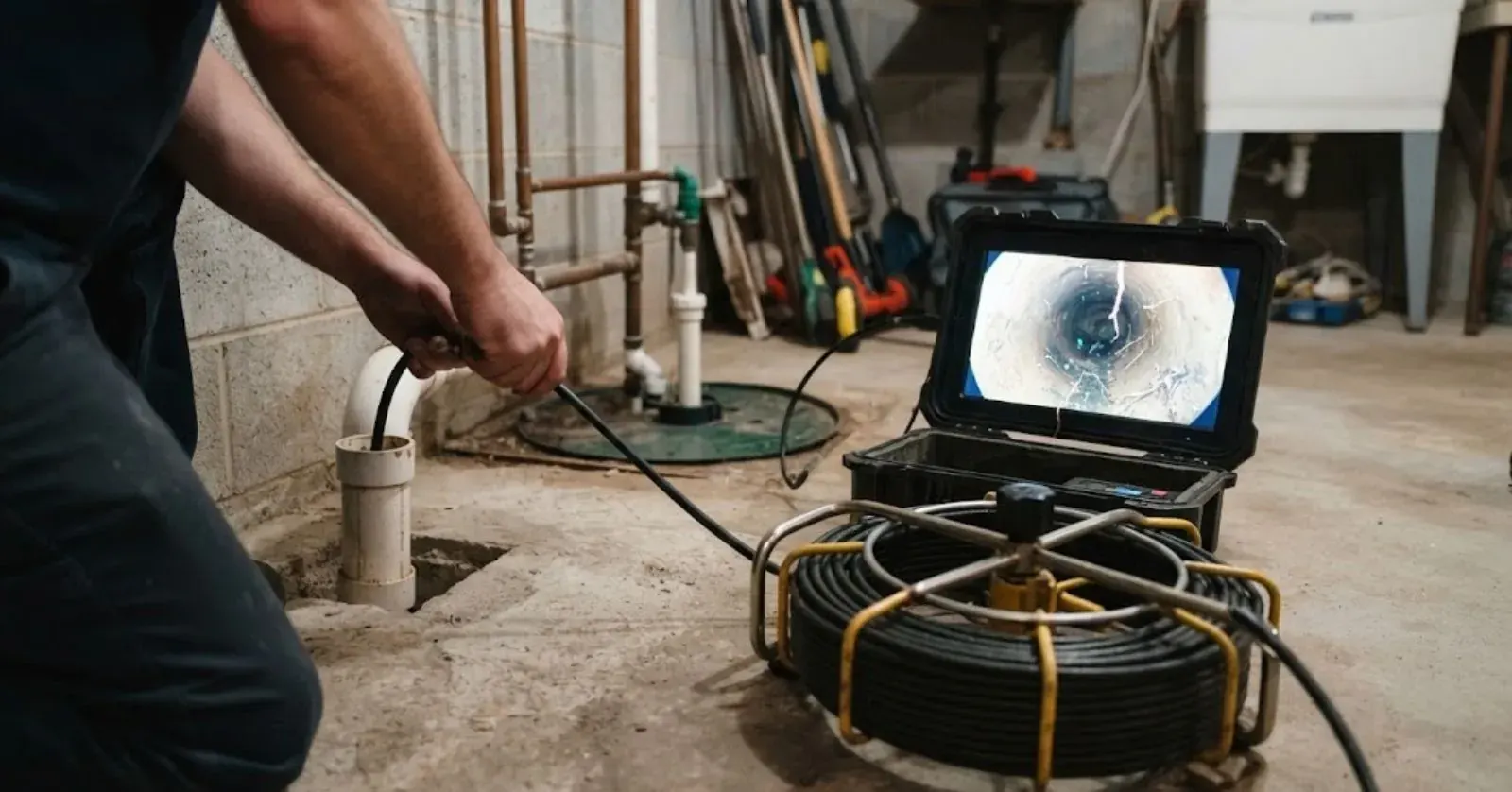
A sewer inspection is a planned camera run through the line that carries waste from your building to the public sewer. Buyers order it before closing on an older house, and owners order it after backups that keep returning. Call dispatch, tell us the address and your timeline, and we schedule a visit, with same-day appointments when available.
The median Brookline home was built in 1938 per Census ACS estimates, so the pipe under many properties is older than anyone alive who installed it. A camera replaces guesswork with a recording you can show a seller, a lawyer or an insurer.
How a sewer camera inspection works
The visit usually takes a fraction of a day. If the line is packed with debris, we clear it first so the lens can pass.
- Find the entry point. A cleanout near the basement floor or the foundation is best. Without one, we pull a toilet or use a roof vent.
- Run the camera. A self-leveling color camera on a push rod travels toward the street while we record video and footage.
- Locate the pipe. A transmitter in the camera head lets a handheld receiver mark the pipe's position and depth on the ground.
- Review together. We stop on any defect, show it on the screen and explain what it means for you.
- Deliver the video. You get the recording and a plain-language list of findings.
Buying an older house?
Call (617) 752-0573 to schedule the camera before your inspection period ends.
What the camera can show you
- Pipe material. Clay, cast iron, plastic or fiber each look different on camera and age differently.
- Cracks and offsets. Broken sections and joints that have slid out of line.
- Roots. Where they enter and how dense the mass is.
- Bellies. Low spots that hold standing water and collect solids.
- Scale and grease. Buildup on the wall that narrows the opening.
- Connections. Branch tie-ins, a backwater valve, a cleanout and a missing section of pipe.
What a camera cannot tell you
The lens cannot see through standing water, so a belly full of water shows as a gap in the picture. It cannot pass a full collapse. It does not measure how fast a crack leaks, and it cannot say what the soil outside the pipe is doing.
It also cannot show the exact property line. The Town's FAQ places the homeowner's responsibility from and including the connection to the public main, so footage to the street helps, but the Town decides what is public. If your report finds nothing, that is a good result, and we say so.
| Question | What the camera shows | What it cannot show |
|---|---|---|
| Is the pipe cracked? | Visible cracks, holes and broken joints | How fast sewage leaks out of them |
| Are there roots? | Where they enter and how dense they are | How far they spread outside the pipe |
| Is there a sag? | A belly shows as standing water or a dip | The pipe beyond a water-filled gap |
| Is it collapsed? | The point where the lens stops | Anything past the collapse |
| Whose pipe is it? | Footage to the street and the connection point | The legal property line |
Inspecting the lateral before you close
A standard home inspection often does not put a camera in the sewer. Because the lateral is the owner's responsibility, it becomes yours at closing, so many buyers add a camera visit during the inspection period. Ask the seller for access and a cleanout location, and book early because contract deadlines are short.
In older multi-family buildings the lateral often serves several units. Brookline has many two-family and larger buildings, so one lateral can carry the waste of several households. Knowing its shape before you buy is worth a call.
When repeat clogs call for a camera
If you have paid for cabling more than once, a camera shows why. Roots, a belly or a broken joint each need a different fix. See sewer line cleaning for clearing the line and sewer line repair for fixing a failed pipe.
A camera is also useful after a repair to confirm the new section is straight and connected. We run the same inspection for buyers in nearby Newton, where lateral rules may differ, so ask the city before assuming.
What sets the price of a sewer inspection
We give a clear price before work starts. A few things shape it.
- AccessAn existing cleanout is simple. Pulling a toilet or going through a vent takes longer.
- Line length and layoutA short straight run is quicker than a long lateral with bends and branches.
- DebrisIf the line needs cleaning before the camera can pass, that is added work.
- LocatingMarking the pipe's path and depth on the ground adds time, and is worth having before digging.
- ReportA written summary and the video for a closing or insurer is part of the visit.
Some homeowner policies cover sewer backup only with an endorsement. A dated video of the line can help document its condition, but check what your policy says before you rely on it.
Want your real number? Call (617) 752-0573.
Sewer inspection questions
Most visits fit in a short appointment, longer if the line needs cleaning first. We tell you the expected time when you call.
Yes. You get the recording and a plain list of what we saw, which you can pass to a seller, lawyer or insurer.
It can show cracks, holes and root entry, which are common sources of leakage. It cannot measure flow through the break. For water supply leaks, see leak detection.
Not always. If you are buying an older house or have had even one unexplained backup, it is worth it. For a well-draining line you have owned for years, it is optional.
We show you the footage and explain your options and the trade-offs. You decide whether to repair, monitor or negotiate with a seller. No repair starts without your approval.
Yes. Tell dispatch whether the line serves several units, since shared laterals take longer to map.
See the pipe before you decide
Call (617) 752-0573 and tell us your address and timeline.