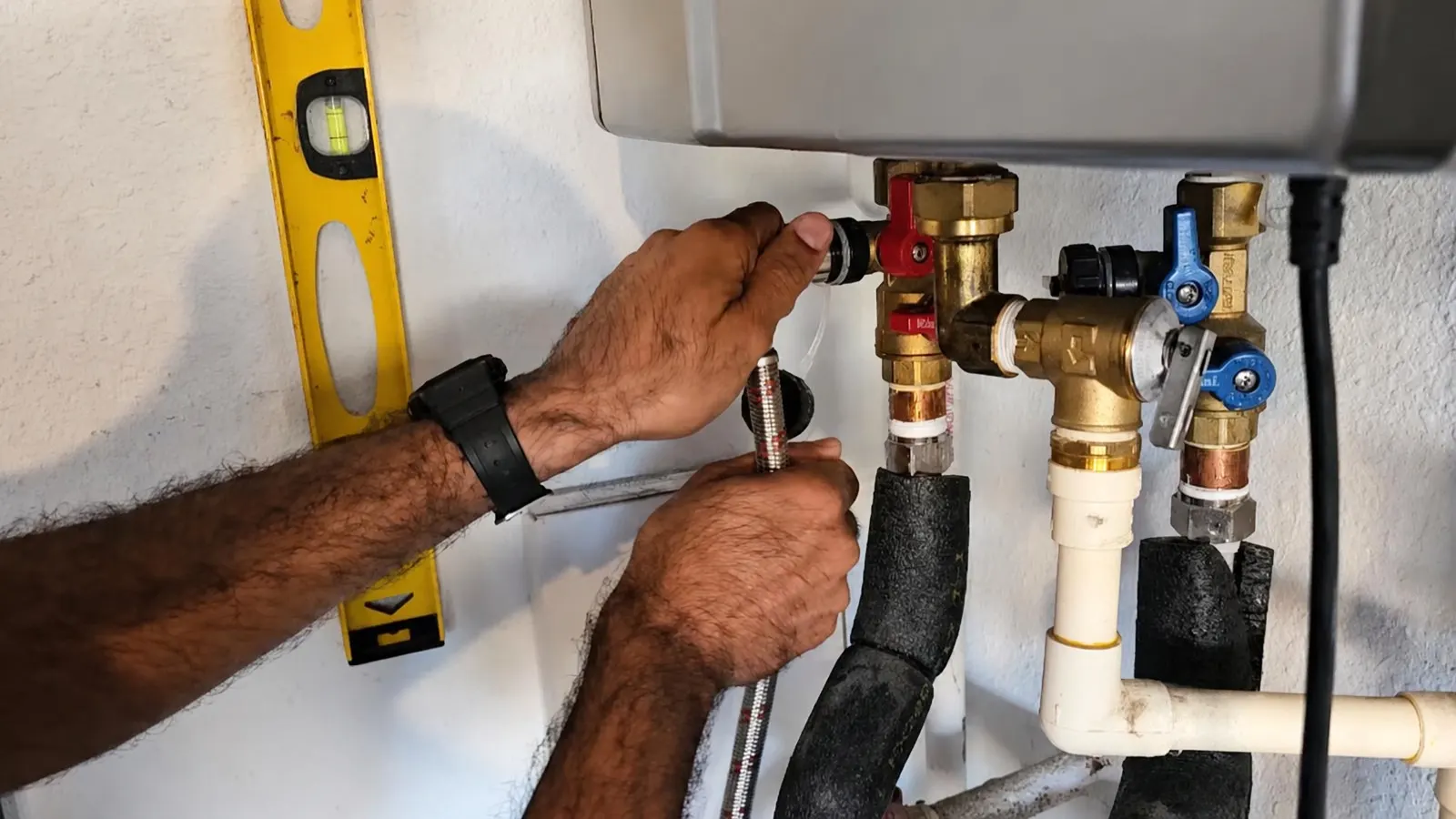
A tankless water heater in Brookline, MA is often a good answer for a household that empties a 40 gallon tank every morning, and a poor answer for a one-person condo with a tight utility closet. We install, repair and flush condensing tankless units, and we tell you plainly when a tank is the smarter buy.
If your current tank is failing and you need hot water now, our water heater replacement page is faster. This page is for people comparing options, or owners of a tankless unit that has started throwing codes.
What a condensing tankless unit does differently
A condensing model pulls extra heat out of the exhaust by running it past a second heat exchanger. The cooled exhaust turns to acidic water called condensate, so the unit needs a drain and a plastic vent pipe instead of a metal flue.
Because the exhaust is cool, the vent can run horizontally out a side wall in plastic pipe. In a Brookline basement with a retired chimney, that opens a path a conventional gas tank could not use.
Not sure it fits?
Call and we will talk through your meter, your wall and your usage.
Signs a tankless heater suits your home
- A side wall or short path outside. The vent and a fresh air intake need an exterior route.
- A gas line that can carry the load. Tankless burners draw far more gas at once than a tank burner, so a small existing line often needs upsizing.
- A floor drain or condensate route. The acidic condensate must reach a drain.
- High hot water demand. Two showers and a dishwasher at once strain a tank but not a correctly sized tankless.
- Wall space. Most units hang on a wall, which frees floor space in a cramped basement.
When a tankless heater does not make sense
Tankless units cost more up front, and savings take years to show. A small household that uses little hot water may never recoup the difference.
A condo with no exterior wall access, or an association that bans new penetrations, can rule it out outright. So can a gas meter or line that cannot be upsized, and low-flow fixtures that fall below the unit's minimum flow so it never fires. In those cases a tank, or a heat pump model, is the better choice.
Tankless versus tank: where each wins
| Factor | Tankless | Tank |
|---|---|---|
| Hot water supply | Continuous while the burner keeps up | Limited to tank volume, then recovery time |
| Footprint | Wall-mounted, small | Floor space, often 20 or more inches wide |
| Venting | Plastic pipe through a side wall | Chimney or direct vent, depending on model |
| Gas line | Often needs upsizing | Usually fine as is |
| Maintenance | Annual flush and descale | Occasional drain and anode rod check |
| Lifespan | Often longer, with care | Shorter, about 8 to 12 years |
For a tank-based alternative see our water heater installation page.
Flushing and descaling a tankless heater
Scale builds on the heat exchanger and shrinks its water passages, so units need periodic flushing with a pump and a descaling solution. Brookline's MWRA water is soft, about 1 grain per gallon, so scale builds more slowly here than in hard-water towns, but it does not disappear.
A yearly flush is still sensible, and skipping it can cost you efficiency and trigger error codes. If your unit beeps and shows a fault code, note the code before you call, since it tells the technician which sensor or vent to test first.
What the town and the code expect
Gas heater work requires a permit, and Brookline does not let homeowners pull plumbing or gas permits. Permit review is about 3 days, and the plumber files for you.
248 CMR also requires a properly sized thermal expansion tank where a meter or backflow device has closed the system, and a relief valve discharge ending within twelve inches of the floor. If you smell gas, leave and call 911 or National Grid at 1-800-233-5325 before calling us.
Tankless in older Brookline buildings and condos
Half of Brookline's homes were built in 1939 or earlier, and many are in multi-unit buildings where gas piping and vent routes were set decades ago. We check the meter, the line run and the wall you would vent through before recommending anything.
We serve neighbors such as Newton, where houses can differ a lot in what the gas line can carry. A site visit beats a phone guess.
What sets the price of a tankless install
The unit is only part of the number. These factors move it most.
- Gas line upsizingThe distance from the meter and the existing pipe size decide how much new pipe is needed.
- Venting routeA short run out a side wall costs less than a long run through floors.
- Condensate drainHow far the nearest drain sits changes the piping.
- Unit capacityA larger household needs a higher-output unit.
- Removal and permitTaking out the old tank and pulling the permit are part of the job.
A planned upgrade is not a covered loss. Mass Save rebates for water heating have focused on heat pump units, so check Mass Save before assuming one applies to a gas tankless.
Want your real number? Call (617) 752-0573.
Tankless questions
Sometimes. It needs a vent path to the outside and a gas line that can carry the load, and your association may need to approve exterior work. We assess both on a site visit.
Yes. We flush the heat exchanger with a pump and descaling solution, and check the vent, intake and condensate drain at the same visit.
Write down the code and any beeping pattern and call dispatch. Many codes point to a clogged vent, a flame sensor or a scaled heat exchanger.
No. MWRA water is soft, so scale forms slowly, but it still forms. A yearly flush is cheap insurance.
Often. Tankless burners draw more gas than a tank burner, so we measure the existing pipe and the run from the meter.
Mass Save's water heating rebates have focused on heat pump models. Check Mass Save for current terms before you plan around any incentive.
Ready to compare options?
Call (617) 752-0573 for a site visit and a straight answer.