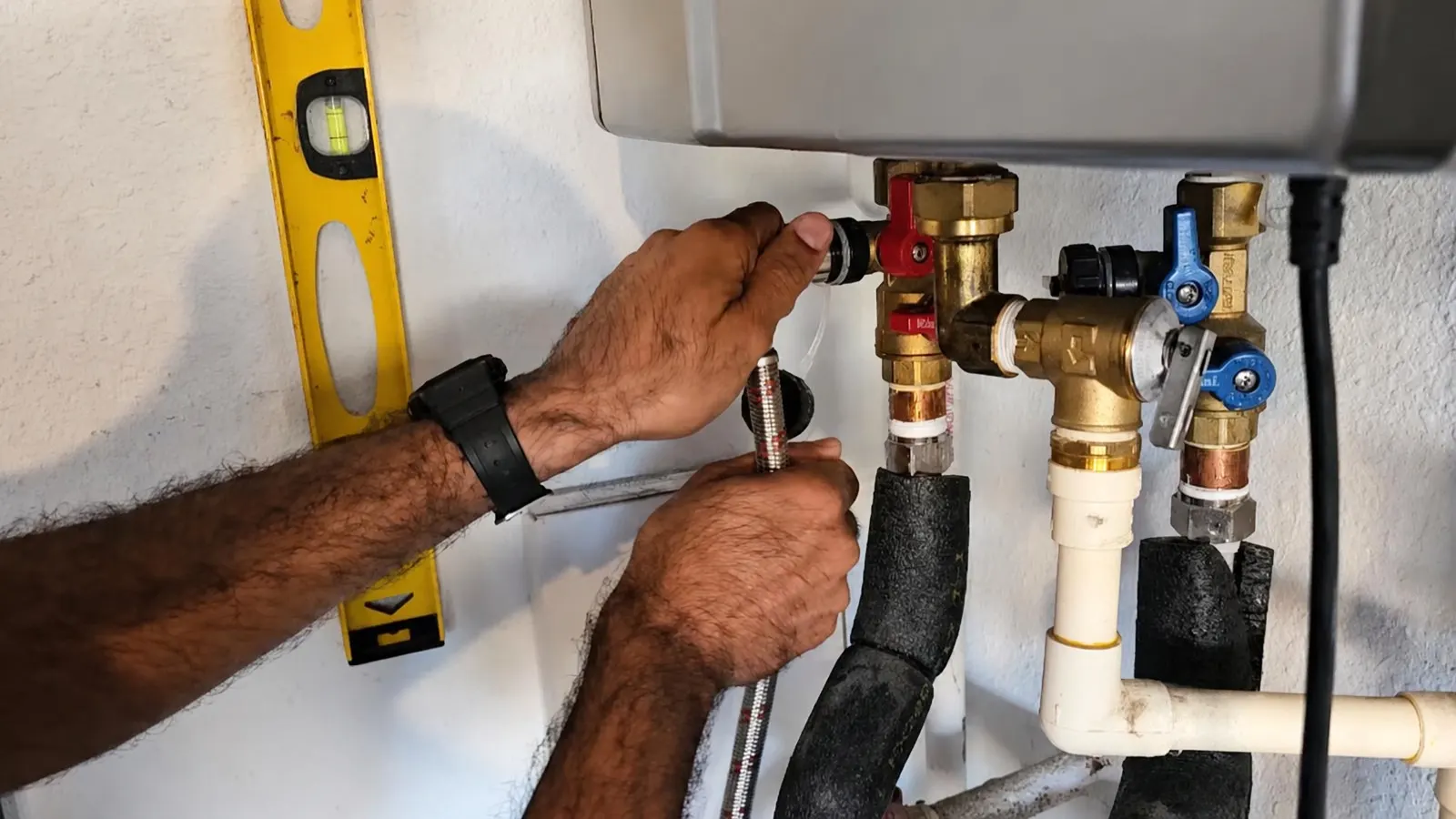
A condensing tankless water heater is a gas-fired on-demand heater with a second heat exchanger that pulls extra heat out of the exhaust. That cooler exhaust turns to liquid water, called condensate, and the unit can vent through plastic pipe instead of metal flue. The result is higher efficiency, but it also means a drain, a neutralizer and different venting.
For a Brookline home, the practical questions are where the vent can exit, where the condensate can drain, whether the gas line is big enough and whether the unit pays back in your use. The sections below take each in turn, with honest limits on what changes in a tight, older house.
What the second heat exchanger does
A standard tankless unit sends exhaust out at several hundred degrees through a metal vent. A condensing unit adds a stainless steel secondary exchanger that captures heat the exhaust would have carried away. The exhaust leaves at roughly the temperature of warm water, so it can travel through plastic pipe.
As the exhaust cools it releases water vapor. That liquid is mildly acidic, which is why condensing heaters carry a drain line and often a small neutralizer cartridge filled with limestone-type media.
Wondering if tankless fits your house?
Tell us about the space and gas meter and we will talk it through.
Condensing versus non-condensing tankless
| Feature | Condensing | Non-condensing |
|---|---|---|
| Heat exchangers | Two, with a stainless secondary | One |
| Vent material | PVC, CPVC or polypropylene, as the maker lists | Stainless steel flue |
| Condensate drain | Required, usually with a neutralizer | Not needed in most cases |
| Typical efficiency | Around 0.95 UEF | Often in the low 0.80s |
| Install complexity | Drain and plastic vent route to plan | Metal vent with tighter clearances |
Ratings vary by model. Check the label on the unit you are considering.
Where the acidic condensate goes
A condensing tankless makes a steady trickle of condensate whenever it fires. The pipe should slope to a drain, and the water should pass through a neutralizer first. Common drain points are a laundry standpipe, a utility sink or a floor drain that connects to the building drain.
Use plastic for this line. Copper, steel and cast iron corrode when acidic water runs through them. The neutralizer needs a check every year, and the media needs replacing when its pH test fails.
In a basement below the street, a floor drain may be lower than the sewer. If a pump is needed to lift the condensate, say so at the quote, because that adds a part that can fail.
PVC venting and where the pipe can exit
Condensing units use PVC, CPVC or polypropylene vent pipe approved by the manufacturer. Many use two pipes, one for intake and one for exhaust, and some use a concentric kit with one pipe inside another.
The pipe must slope back to the unit so condensate does not pool, and it must exit at the distances the manufacturer lists from windows, doors and the property line. In a row house or a three-decker, the exit point is often the limiting factor. A rear wall may work where a front wall cannot.
A vent that ices or snows over will shut the unit down. In Massachusetts winters, the termination height and location matter more than most buyers expect.
Your gas line may be too small
A tank-type heater burns a small flame for a long time. A tankless unit fires at full rate for a short time, often several times the input of a tank heater. If the existing gas line was sized for a small tank heater, a plumbing and gas fitting plan may call for a larger pipe from the meter or a shorter run.
Gas work is permitted work. Brookline's Building Department states that homeowners cannot pull gas permits in town, so a licensed individual must do the job. If you smell gas at any time, leave the building and call 911 or National Grid at 1-800-233-5325 before calling us.
Efficiency, payback and the honest trade-offs
Condensing tankless units are commonly rated around 0.95 UEF, while non-condensing tankless units are often in the low 0.80s. That gap adds up for a house with steady hot water use, such as a family of four with laundry and long showers.
For a single person or a vacation unit, the gas savings may take many years to repay the added install work. A tankless unit also does not give unlimited hot water. If two showers and a dishwasher run at once, the flow rate can outrun the heater.
- Strengths: . endless hot water at modest flow, small footprint, wall mounted, lower gas use per gallon.
- Limits: . higher purchase price, more install work, condensate drain, annual flush, and a short lag before hot water arrives.
- Not ideal: . tight spaces where the vent cannot exit properly or homes with very small gas lines.
Flushing and descaling a condensing unit
Plan on a yearly flush. A pump, two hoses and a bucket of descaler or white vinegar circulate through the heat exchanger to clear mineral buildup. The condensate trap and neutralizer get checked at the same visit.
MWRA water is soft, so scale builds more slowly than in hard-water regions, but flushing is still part of the manufacturer's maintenance. A unit that is skipped for years can trip error codes for flow or temperature. Our tankless water heater visits include checking that condensate path.
Local rules and incentives to know
Per the Census Bureau's American Community Survey for 2020 to 2024, 65.0 percent of Brookline's housing units were built before 1960, and the median build year is 1938. Older homes often have gas piping sized for older appliances and tight spots for venting, so the gas line check is the first part of any tankless quote.
Mass Save lists a heat pump water heater rebate for replacing electric, propane, gas or oil water heaters. When we checked the Mass Save water heating page and the 2026 rebate sheet, no rebate for gas tankless or condensing water heaters was listed. Check current Mass Save terms before you buy, since programs change.
Per 248 CMR 10.00, residential hot water is held between 120 and 130 degrees Fahrenheit. Plumbing and gas permits in Brookline go only through licensed individuals, and review takes about three days according to the Building Department.
When a tank or a heat pump unit makes more sense
A standard tank can be the better fit in a small apartment with limited venting, a tight budget or very light use. Our water heater installation work includes both tank and tankless, and we will say which suits your house after we see the space.
Heat pump water heaters are another option, and they have a rebate in Massachusetts. Ask on the phone about the electrical and clearance needs, which are different from a gas unit.
What moves the price of a condensing tankless install
No two installs match. These are the items that push the number up or down.
- Gas line upgradeA longer or larger pipe run from the meter adds material and labor.
- Vent routeA short straight run through a rear wall costs less than a long run through floors.
- Condensate pathA nearby floor drain is simple. A pump or a long run to a drain adds parts.
- Unit sizeLarger input and flow ratings suit bigger households and cost more.
- Removal and repairsTaking out an old flue or tank, and patching where it passed through, affect time on site.
A new heater does not usually change coverage, but tell your insurer about a gas appliance change if your policy asks for it.
Want your real number? Call (617) 752-0573.
Condensing tankless questions
It is worth it for steady, daily hot water use and a house where the vent and gas line work out. For light use, the savings take longer to repay the added install work.
Yes. Exhaust cools into acidic condensate, which must drain through plastic pipe and usually a neutralizer. Floor drains and laundry standpipes are common choices.
Condensing units are designed for approved plastic vent pipe, but only the type and size the manufacturer lists. A licensed plumber and gas fitter should lay out the run.
Mass Save listed a heat pump water heater rebate, but no gas tankless or condensing rebate when we checked. Check current Mass Save terms before you buy.
Yes. MWRA water is soft, but flushing is part of the maker's upkeep plan. Do it yearly and check the condensate neutralizer at the same visit.
Gas lines sized for older appliances may be too small, and vent exits may be limited. We check the meter run and the wall options before quoting.
Yes. Brookline borders both. See our Newton service area and Jamaica Plain coverage.
Plan the vent, drain and gas line first
Call (617) 752-0573 to set up a visit.