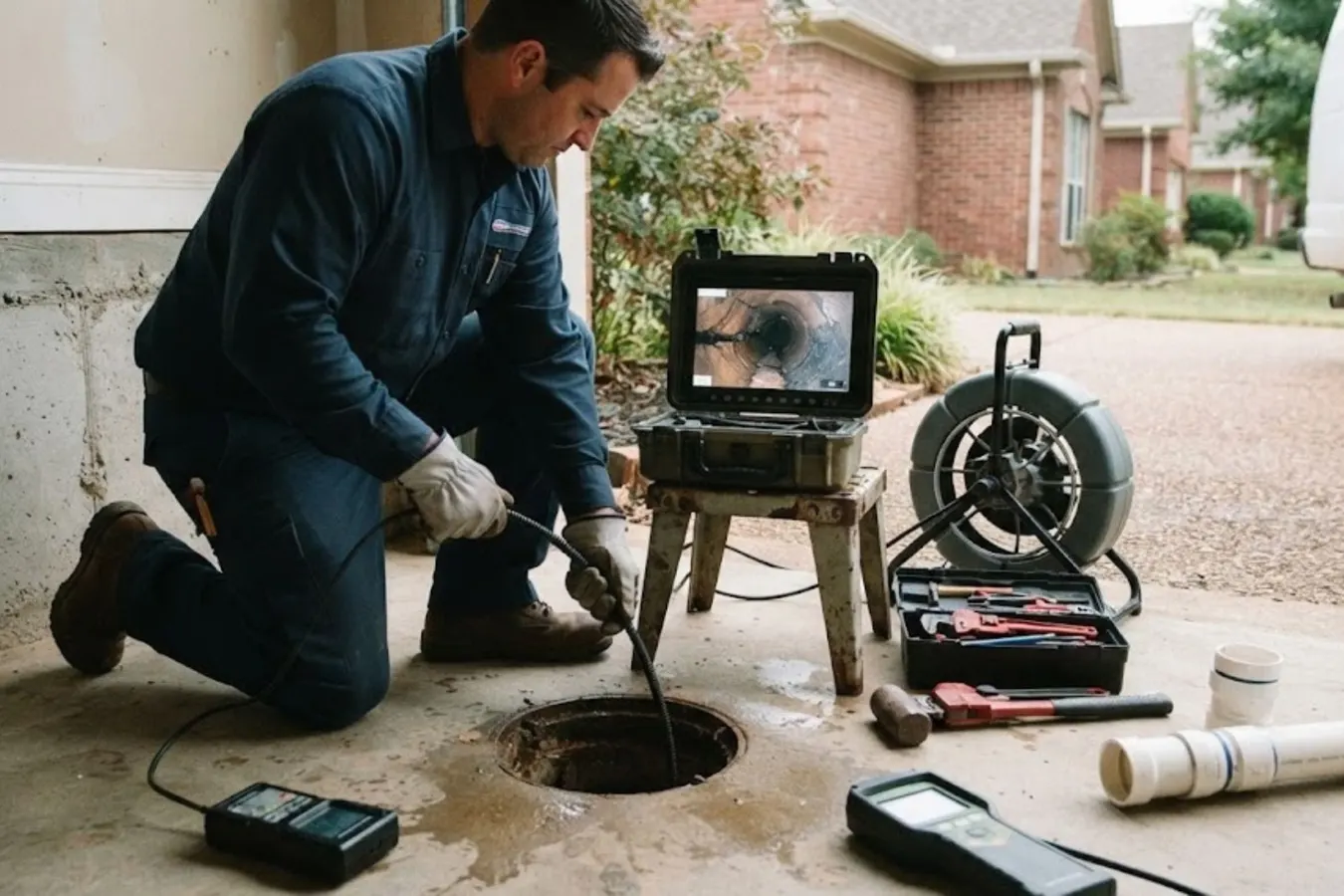
A damaged sewer line shows up as repeat backups, gurgling drains in more than one fixture, a sewer smell in the basement, or a lawn that stays wet and green over the pipe's path. The usual causes are tree roots working into joints, old pipe that has cracked or corroded, and a sag called a belly where the pipe has settled and holds waste. A camera inspection is the only way to see which one you have.
In Brookline the repair question has a second half: which part of the pipe is yours. The Town's sewer FAQ draws a clear line, and knowing it before you call saves a wasted afternoon. Both halves are below, along with repair options and the permit steps.
Signs the sewer line is damaged
One slow drain is usually local. These point at the line that leaves the house.
- Backups in several fixtures. A basement floor drain that bubbles when the washing machine runs, or a toilet that gurgles when a tub drains.
- Repeat clogs. A line cleared last season and blocked again is often catching on a root, a crack or a belly.
- Sewer smell. Odor in the basement or at an outside cleanout means gas or waste is escaping from a defect.
- Wet or lush patch outdoors. A spot that stays soggy or greener than the rest of the yard can sit above a leak.
- Settling soil. A sunken area or a crack in a slab can follow a washout around a failed pipe.
Seeing a backup now?
Stop using water and call dispatch.
What damages a sewer line
Roots. Roots enter at joints looking for moisture, then grow into a mat that catches paper and waste. Clay pipe with short sections has many joints, which is why it is vulnerable.
Age and material. Cast iron rusts from the inside, shedding flakes and narrowing the bore. Clay cracks. Older Brookline homes often have one of these, though only a camera tells you which.
Belly. Soil settles under a pipe and a low spot forms. Waste collects in the dip, so the line clogs repeatedly even after cleaning. A belly shows on camera as standing water in the pipe.
Who owns which part of the pipe
Brookline's sewer FAQ says the homeowner is responsible for the service line from and including the connection to the public sewer main, and that the Town is responsible for blockages within the public sewer main. A sewer pipe must be repaired by a Licensed Drain Layer, per the same FAQ.
For a backup you suspect is in the main, the Town lists 617-730-2175 for sewer backups. A camera run on your own line tells you which side the problem is on, and a crew that finds it in the Town's main can hand you a clear answer rather than a guess.
How we diagnose before anyone digs
A camera on a flexible cable goes in through a cleanout or a pulled toilet, and it records the pipe's interior as it travels toward the street. The footage shows roots, offsets, cracks, scale and any belly. A locator can then mark the surface above any defect so the repair is measured in feet, not guesses.
Our sewer inspection service covers this step, and a clear picture first usually saves money later. If the line is only coated or rooted, sewer line cleaning can clear it without any repair.
Repair options and honest trade-offs
Lining and bursting both reduce digging, but neither is right for every pipe. A lined pipe still needs the right slope, and bursting needs a clear path. Our sewer line repair team will explain which method fits your footage and why.
| Option | Best for | Trade-off |
|---|---|---|
| Cleaning only | Roots or scale in sound pipe | Roots return if joints are open |
| Spot repair | One cracked or offset section | Does not help the rest of an aging line |
| Pipe lining | Long runs with cracks but a true grade | Cannot fix a belly or a collapsed pipe |
| Open trench replacement | Collapsed, bellied or crushed pipe | More disruption to the yard, driveway and landscaping |
| Pipe bursting | Replace a line along its old path | Needs entry and exit pits and a clear route |
Which one fits depends on what the camera shows. Ask to see the footage before agreeing to a method.
The backwater valve policy
If your home has fixtures below the street level, a backwater valve can stop sewage from flowing back in during a surcharge. Brookline's backwater valve policy covers fixtures below the roadway and cites 248 CMR 10.15. It requires a licensed plumber and a Building Department permit.
The same policy says that installing and maintaining the valve is the owner's responsibility. A valve that is never opened and cleaned can stick, so schedule a check once a year.
Permits and calls before any excavation
Homeowners cannot pull plumbing permits in Brookline. The Building Department says work must be done by licensed individuals, and review takes about three days. Permits are requested through the Town's online Accela portal. Your plumber handles that step.
Before any digging, call 811. State law requires the call at least 72 hours ahead, not counting weekends and legal holidays, so utilities can mark gas, electric and water lines. A sewer repair also usually needs a licensed drain layer for the work in the ground.
What the Town says about sewers
Per Brookline's DPW sewer FAQ, owners are responsible for the sewer service line from the main connection to the home and the Town is responsible for blockages in the public main. The Town's Sanitary Sewer Overflow page also says downspouts and sump pumps must not discharge to the sewer, and that wipes do not degrade in the sewer system and can cause clogs.
Census ACS data for 2020 to 2024 show a median year built of 1938 for Brookline housing, so many service lines are old enough to have had a repair or two. The Town's lower Beacon Street project separated a combined sewer system described by the engineer as 110 years old. Whether your own street still has a combined sewer is a question for the Town, so ask before you plan a repair.
In neighboring Boston neighborhoods such as Jamaica Plain, the water and sewer commission maintains the main and the owner is responsible for the entire lateral, per its published guidance. In Newton the rule was not confirmed from a source, so Newton owners should ask the city.
Sewer line damage questions
A clog usually clears and stays clear. Damage keeps returning, often at the same fixtures, and a camera shows roots, cracks or a belly. If you have had more than one backup in a year, ask for an inspection instead of another cleaning.
No. Roots can enter an open joint on an otherwise sound pipe. Cutting them clears the flow, but the joint stays open, so roots usually return. A camera tells you whether the pipe can be lined or needs replacing.
Per Brookline's sewer FAQ, the Town is responsible for blockages in the public main, and the homeowner is responsible for the service line from the connection to the main. Call 617-730-2175 if you think the backup is in the main.
It matters if you have fixtures below the street level. Brookline's policy covers fixtures below the roadway and requires a licensed plumber and a Building Department permit. The owner maintains it, so it needs periodic checking.
Yes. Dispatch answers 24/7. If sewage is coming up through a floor drain, stop using water, keep people out of the wet area and call (617) 752-0573. Same-day appointments are available when schedules allow.
No. Per the Town, a sewer pipe must be repaired by a Licensed Drain Layer, and homeowners cannot pull plumbing permits. A plumber also handles the connection work and the permit.
Want to see the pipe before deciding?
Call (617) 752-0573 to schedule a camera visit.